2010 Honda Crosstour Reliability Report
NHTSA data as of Oct 15, 2026Published Oct 23, 2026
Ranks 3rd of 6 Crosstour years we score.
- Owner complaints
- 82
- 5 are recall notices
- Per 10,000 cars
- 22.5
- 34,175 made for the U.S.
- Vs the average car
- 0.55×
- same age, 1× is average
- Serious outcomes
- 22
- crash, fire, injury, stall or tow
- Recalls
- 9
- NHTSA crash rating
- Not rated
- no overall rating before 2011
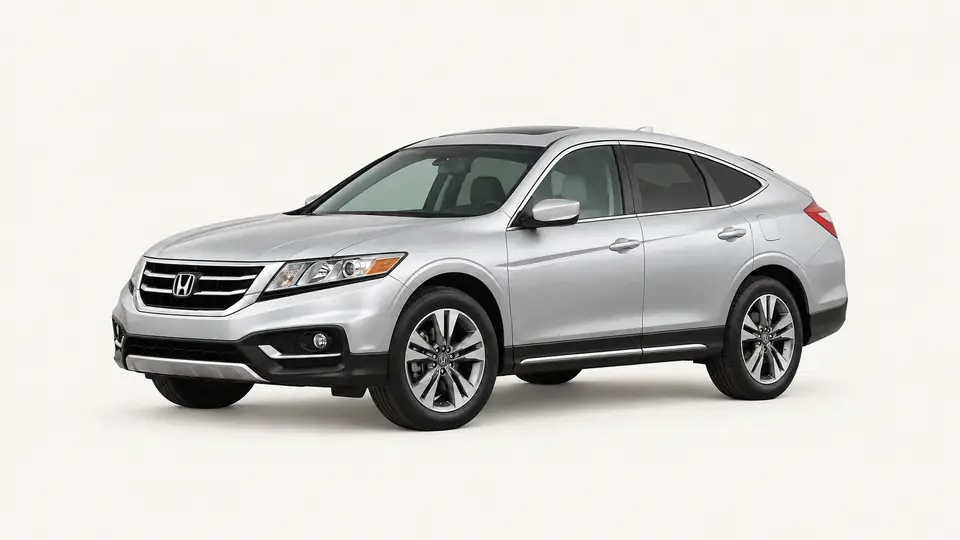
Should You Buy the 2010 Honda Crosstour?
Yes, with the usual checks. Our reliability score for the 2010 Honda Crosstour is 75 out of 100, which rates Good. Owners reported about half as many problems as for the average car of the same age. It ranks 3rd of the 6 Crosstour years we score.
The most reported problem is high oil consumption, mostly burning or using oil (15 of 82 complaints). Owners also complain about the ignition coil or spark plug and the driveshaft or CV axle. 22 of the 82 complaints describe a serious outcome, such as a crash, a fire, an injury or stalling while driving.
It has 9 recalls. Honda also offers three warranty extensions that may still apply, for problems with the transmission and engine. For comparison, the 2011 scores 84.
Before you buy, check that the recalls were done, ask a Honda dealer about warranty extension 16-066 and get an independent inspection. The full checklist is at the end of this page.
Pros
- Good reliability score of 75
- About half the problems of the average car its age
- No do-not-drive or park-outside recalls
- 3 Honda warranty extensions may cover repairs
Cons
- Engine oil consumption: burning or using oil15 complaints
- Ignition coils or spark plugs: rough running or misfires9 complaints
- CV axles: vibration or shudder8 complaints
How the 2010 Crosstour Earned Its Score
Every model year starts at 100. Each part takes points away when this year has more problems than the average car of the same age. How we score
| Item | Vs average | Points lost |
|---|---|---|
| Starting score | 100 | |
| Serious problems22 complaints · average car: about 49 | 0.47× | −11 |
| Everyday problems55 complaints · average car: about 73 | 0.76× | −6 |
| Problems in the last two years3 complaints · average car: about 2.1 | Not counted | – |
| Recalls9 recalls · average car: about 4.3 | 1.7× | −8 |
| Score | 75 |
The last two years are not counted for the 2010 Crosstour. Honda made 34,175 of them, and at this age an average car made in that number would get only about 3.6 complaints of any kind in two years. We need at least 5 to compare, so we leave this part out. Its 30% goes to serious and everyday problems instead, so they make up 80% of the score rather than 50%.
Each part shows two counts: this year's so far, and what an average car would have at the same age. For complaints, that average car was made in the same number as this one. “Vs average” compares the two counts, but in our scoring system we first add a little to both, so a few complaints cannot swing the result. That is why it is not simply one count divided by the other. The last two years count only complaints about five systems: the engine and fuel system, transmission, brakes, steering, and airbags and seat belts.
What Owners Report
We read all 82 complaints filed with NHTSA for the 2010 Honda Crosstour, one by one, and grouped them by the problem they describe. The most reported problems come first. A complaint that describes more than one problem is counted under each, so the counts add up to more than 82.
Engine oil consumption: burning or using oil
15 complaints (18%)
Burning or using oil. 3 of these 15 complaints describe a serious outcome, most often being stranded. Median mileage when it started: about 75,000 miles.
Ignition coils or spark plugs: rough running or misfires
9 complaints (11%)
Rough running or misfires and a failure that needed a new part. 1 of these 9 complaints describes a serious outcome: a tow. Median mileage when it started: about 94,000 miles.
CV axles: vibration or shudder
8 complaints (10%)
Vibration or shudder, unusual noises and parts breaking or coming apart. Median mileage when it started: about 60,000 miles.
Brakes: vibration or shudder
6 complaints (7%)
Vibration or shudder, spongy pedal that sinks toward the floor and a failure. Median mileage when it started: about 13,000 miles.
Engine (misfire codes): rough running or misfires
5 complaints (6%)
Rough running or misfires. Median mileage when it started: about 98,000 miles.
Engine sensors or computer: stopped working
5 complaints (6%)
A feature that stopped working, stalling and a failure that needed a new part. 1 of these 5 complaints describes a serious outcome: stalling or losing power while driving. Median mileage when it started: about 56,000 miles.
Vibration (cause not stated)
5 complaints (6%)
Vibration or shudder. Median mileage when it started: about 23,000 miles.
Stall (cause not stated)
4 complaints (5%)
Stalling. 3 of these 4 complaints describe a serious outcome, most often stalling or losing power while driving.
Unintended acceleration (cause not stated)
4 complaints (5%)
Sudden acceleration. All 4 describe a serious outcome, most often sudden acceleration or braking.
Noise (cause not stated)
3 complaints (4%)
Unusual noises.
Piston rings failure
3 complaints (4%)
A failure. 1 of these 3 complaints describes a serious outcome.
Ball joints and control arms: parts breaking or coming apart
2 complaints (2%)
Parts breaking or coming apart. 1 of these 2 complaints describes a serious outcome: a tow.
Check engine light (cause not stated)
2 complaints (2%)
Warning lights and a stored fault code.
Engine: a fire
2 complaints (2%)
A fire and high rpm at times. 1 of these 2 complaints describes a serious outcome: a fire.
Exhaust or catalytic converter failure
2 complaints (2%)
A failure.
Show 6 more problems
Instrument cluster: the system not working when needed
2 complaints (2%)
The system not working when needed.
Interior trim: parts breaking or coming apart
2 complaints (2%)
Parts breaking or coming apart. Both describe a serious outcome, most often an injury.
Poor acceleration (cause not stated)
2 complaints (2%)
Hesitation.
Sunroof glass (shattered): shattering or cracking
2 complaints (2%)
Shattering or cracking. Both describe a serious outcome, most often an injury.
Variable cylinder management (VCM): rough running or misfires
2 complaints (2%)
Rough running or misfires and vibration or shudder.
Windshield: shattering or cracking
2 complaints (2%)
Shattering or cracking and delamination.
Reported Once (21)
Show the 21 problems reported once
- A/C failure
- ABS: warning lights
- AWD or rear differential: a leak
- VTC actuator: sticking or stiffness
- Airbag warning light
- Alternator or charging failure
- Several warning lights at once
- Door latches: works on and off
- Loss of power (cause not stated)
- Oil pressure: warning lights
- VCA light (cause not stated)
- Eco system: a leak
- Vehicle fire (origin not stated) (cause not stated)
- Parking brake: sticking or stiffness
- Door lock actuators: stopped working
- Stability control (VSA) failure
- Steering
- Sunroof: combusted
- Tires: shattering or cracking
- Transmission: harsh or delayed shifts
- Valve train: rough running or misfires
How the 2010 Honda Crosstour Compares With Other Years
Every Crosstour year is here: the Crosstour was made in one generation, 2010 to 2015.
| Year | Rating | Score | Vs average | Per 10k cars | Recalls | Most reported problem |
|---|---|---|---|---|---|---|
| 2015 | Good | 72 | 0.96× | 25.1 | 3 | Starter: the car not starting |
| 2014 | Good | 71 | 1.1× | 31.6 | 3 | Starter: the car not starting |
| 2013 | Good | 70 | 1.1× | 34.3 | 4 | Steering: stopped working |
| 2012 | Excellent | 81 | 0.40× | 13.6 | 7 | CV axles: vibration or shudder |
| 2011 | Excellent | 84 | 0.28× | 11.3 | 7 | Engine oil consumption: burning or using oil |
| 2010 This year | Good | 75 | 0.55× | 22.5 | 9 | Engine oil consumption: burning or using oil |
2010 Honda Crosstour Recalls
Nine recalls cover the 2010 Honda Crosstour. The most recent was issued in June 2019: “Passenger Frontal Air Bag Inflator May Explode.” A VIN check at NHTSA shows which are still open on a given car.
Passenger Frontal Air Bag Inflator May Explode, June 2019
An inflator explosion may result in sharp metal fragments striking the driver or other occupants resulting in serious injury or death.
NHTSA 19V502000Recall report (PDF)Owner letter (PDF)Issued Jun 27, 2019. By the fourth quarter of 2020, 36% of the cars in this recall had been fixed.
Improperly Installed Passenger Air Bag Inflator
An incorrectly installed air bag inflator may not properly deploy the passenger frontal air bag in the event of a crash, increasing the risk of injury.
NHTSA 19V378000Recall report (PDF)Owner letter (PDF)Issued May 16, 2019. By the fourth quarter of 2020, 49% of the cars in this recall had been fixed.
Passenger Frontal Air Bag Inflator May Explode, September 2018
An inflator explosion may result in sharp metal fragments striking the driver or other occupants resulting in serious injury or death.
NHTSA 18V661000Recall report (PDF)Owner letter (PDF)Issued Sep 27, 2018. By the first quarter of 2020, 78% of the cars in this recall had been fixed.
Improperly Installed Passenger Air Bag
An incorrectly installed air bag may deploy improperly in the event of a crash, increasing the risk of injury.
NHTSA 18V268000Recall report (PDF)Owner letter (PDF)Issued Apr 26, 2018. By the third quarter of 2019, 85% of the cars in this recall had been fixed.
Passenger Frontal Air Bag Inflator May Explode, January 2018
An inflator explosion may result in sharp metal fragments striking the driver or other occupants resulting in serious injury or death.
NHTSA 18V042000Recall report (PDF)Owner letter (PDF)Issued Jan 9, 2018. By the second quarter of 2019, 72% of the cars in this recall had been fixed.
Incorrectly Installed Replacement Air Bag
In the event of a crash, an incorrectly installed passenger frontal air bag inflator may deploy the air bag improperly, increasing the risk of injury.
NHTSA 17V545000Recall report (PDF)Owner letter (PDF)Issued Aug 31, 2017. By the first quarter of 2019, 94% of the cars in this recall had been fixed.
Show 3 more recalls
Passenger Frontal Air Bag Inflator May Rupture, January 2017
An inflator rupture may result in metal fragments striking the vehicle occupants resulting in serious injury or death.
NHTSA 17V030000Recall report (PDF)Owner letter (PDF)Issued Jan 10, 2017. By the second quarter of 2018, 70% of the cars in this recall had been fixed.
Passenger Frontal Air Bag Inflator May Rupture, May 2016
An inflator rupture may result in metal fragments striking the vehicle occupants resulting in serious injury or death.
NHTSA 16V346000Recall report (PDF)Owner letter (PDF)Issued May 24, 2016. By the first quarter of 2018, 64% of the cars in this recall had been fixed.
Frontal Air Bags Modules
In the event of a crash, the front passenger airbag may not deploy as intended and could place an unbelted child seated in the front passenger seat at greater risk of injury should the airbag deploy.
NHTSA 10V402000Owner letter (PDF)Issued Sep 8, 2010.
2010 Honda Crosstour Warranty Extensions and Programs
Honda has three warranty extensions and five customer support programs for the 2010 Honda Crosstour, separate from its recalls. They are for problems with the airbags, transmission and engine. One has ended. Whether one applies to a car depends on its VIN, which a Honda dealer can check.
- Warranty extensionHonda 16-066
Torque converter judder software update
- The problem:
- The torque converter lock-up clutch can make the car judder, shudder or vibrate at 20 to 45 mph.
- The fix:
- A Honda dealer updates the transmission software and replaces the transmission fluid for free. If the judder comes back, the torque converter may be replaced under program 16-067.
- Who qualifies:
- The owner must report a judder before the update is done. The VIN must show as eligible.
- Coverage:
- 8 years or 105,000 miles from the original purchase date, whichever comes first. After that, the owner pays for the update.
- Warranty extensionHonda 13-079
Engine misfire from piston rings fouling spark plugs
- The problem:
- Piston rings can turn and line up, which can foul the spark plugs. The engine then misfires and the check engine light comes on.
- The fix:
- A Honda dealer repairs the misfire for free. Owners who paid for past repairs may claim repayment through the class action settlement, not at a dealer.
- Who qualifies:
- Only V6 cars qualify. A cylinder misfire fault must be stored and the spark plugs must be fouled. Cars with a salvage or branded title are not covered. The VIN must show as eligible.
- Coverage:
- 8 years from the original purchase date, with no mileage limit for these misfire repairs.
- Warranty extensionHonda 16-067
Torque converter replacement for judder
- The problem:
- The torque converter can be damaged and make the car judder, shudder or vibrate at 20 to 45 mph.
- The fix:
- A Honda dealer replaces the torque converter for free. Owners who paid earlier to have the transmission removed for a damaged lock-up clutch may be repaid.
- Who qualifies:
- The judder must come back after the earlier software update 16-066. A Honda dealer test must show the torque converter is damaged. Cars with a salvage or branded title are not covered. The VIN must show as eligible.
- Coverage:
- 8 years or 105,000 miles from the original purchase date, whichever comes first.
- Customer support programHonda 18-052, 18-055, 19-003 and 20-016
Front passenger's airbag inflator
4 programs with the same terms. Which one applies depends on the VIN.
- The problem:
- The front passenger's airbag inflator can be faulty, and the airbag warning light comes on.
- The fix:
- A Honda dealer replaces the front passenger's airbag inflator for free.
- Who qualifies:
- The airbag warning light must be on. A Honda dealer test must show the inflator is faulty. Only replacement inflators that fail later are covered. Open inflator recalls must be done first. Salvage or branded titles are not covered.
- Coverage:
- 18-052: Covered until January 31, 2027.
- 18-055: Covered until January 31, 2028.
- 19-003: Covered until September 30, 2028.
- 20-016: Covered until January 31, 2030.
Another program for the same problem, Honda 18-066, has ended.
Bulletin 18-052 (PDF)Bulletin 18-055 (PDF)Bulletin 19-003 (PDF)Bulletin 20-016 (PDF)
NHTSA Crash Test Ratings
NHTSA gave the 2010 Crosstour no overall, frontal or side rating. It did rate each seat in those tests and lists the seat ratings under Rating Breakdown on its page. We show them the same way below. These tests are from before 2011, so the stars are not comparable with ratings for 2011 and newer models. See the 2010 Crosstour ratings on NHTSA.gov.
Accord Crosstour 4-door with side airbags
Check Before You Buy
A checklist for the 2010 Crosstour, from its nine recalls, three Honda warranty extensions that may still apply and the problems owners report most.
Confirm the Recalls Were Done
Ask the seller for proof that each of these recalls was repaired.
- Passenger Frontal Air Bag Inflator May Explode, June 2019 NHTSA 19V502000
- Improperly Installed Passenger Air Bag Inflator NHTSA 19V378000
- Passenger Frontal Air Bag Inflator May Explode, September 2018 NHTSA 18V661000
- Improperly Installed Passenger Air Bag NHTSA 18V268000
- Passenger Frontal Air Bag Inflator May Explode, January 2018 NHTSA 18V042000
- Look up the VIN at NHTSA to see all 9 recalls and which are still open.
Ask a Honda Dealer
Ask whether each of these warranty extensions applies to this VIN, and whether the work was done.
- 16-066: torque converter judder software update
- 13-079: engine misfire from piston rings fouling spark plugs
- 16-067: torque converter replacement for judder
On the Test Drive
- Ask how often oil is added between changes, and watch for blue smoke at startup.
- Have the engine scanned for stored misfire codes. A rough idle or a flashing check-engine light is a warning sign.
- Brake firmly from a moderate speed. A soft, hard or pulsing pedal, or a brake warning light, is a warning sign.
Ask the Seller
Ask whether any of these were ever repaired, and ask to see the receipts.
- High oil consumption
- Ignition coil or spark plug
- Driveshaft or CV axle
- Also ask for the service records, especially oil changes and transmission fluid changes.
Before You Pay
- Get an independent pre-purchase inspection from a mechanic you choose.
- Decode the VIN to confirm the model year, engine and trim.
- Check the title for salvage, flood or rebuilt branding.
What to do next