2019 Audi e-tron Reliability Report
NHTSA data as of Oct 15, 2026Published Oct 19, 2026
Ranks 3rd of 4 e-tron years we score.
- Owner complaints
- 82
- 13 are recall notices
- Per 10,000 cars
- 66.2
- 10,417 made for the U.S.
- Vs the average car
- 0.75×
- same age, 1× is average
- Serious outcomes
- 23
- crash, fire, injury, stall or tow
- Recalls
- 5
- NHTSA crash rating
- 5★
- overall, out of 5
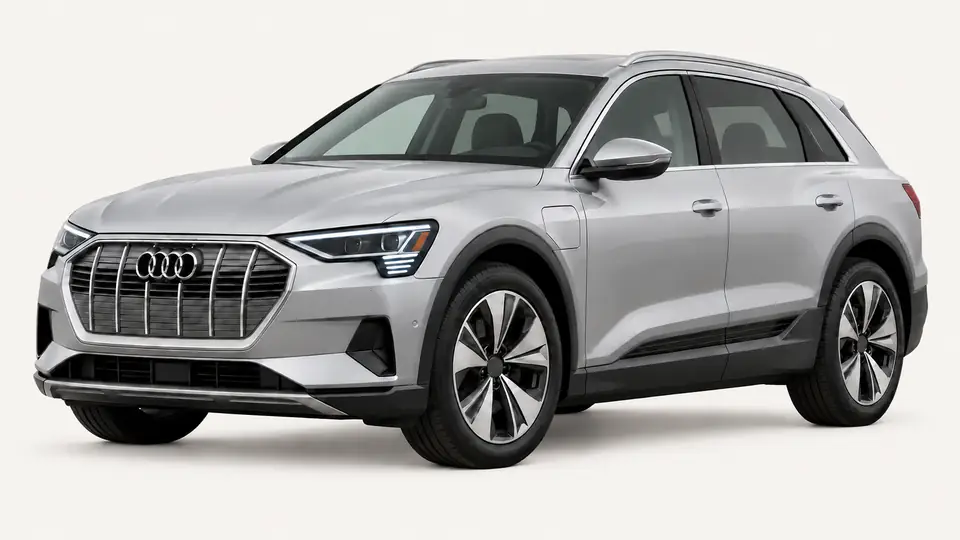
Should You Buy the 2019 Audi e-tron?
Yes, with the usual checks. Our reliability score for the 2019 Audi e-tron is 72 out of 100, which rates Good. Owners reported fewer problems than for the average car of the same age. It ranks 3rd of the 4 e-tron years we score.
The most reported problem is the hybrid or high-voltage battery (9 of 82 complaints). Owners also complain about EV charging and the electric drive motor or inverter. 23 of the 82 complaints describe a serious outcome, such as a crash, a fire, an injury or stalling while driving.
It has 5 recalls. Audi also offers four warranty extensions that may still apply, for problems with the drive axles, sunroof, dashboard and driver assistance systems. NHTSA rates it 5 out of 5 stars overall in crash tests.
Before you buy, check that the recalls were done, ask an Audi dealer about warranty extension AWA-23-02 and get an independent inspection. The full checklist is at the end of this page.
Pros
- Good reliability score of 72
- Fewer problems than the average car its age
- No do-not-drive or park-outside recalls
- 5-star NHTSA overall crash rating
Cons
- Hybrid battery failure9 complaints
- EV charging: stopped working8 complaints
- Electric drive motor or inverter failure8 complaints
How the 2019 e-tron Earned Its Score
Every model year starts at 100. Each part takes points away when this year has more problems than the average car of the same age. How we score
| Item | Vs average | Points lost |
|---|---|---|
| Starting score | 100 | |
| Serious problems | 0.69× | −9 |
| Everyday problems | 0.89× | −4 |
| Problems in the last two years | 1.2× | −10 |
| Recalls | 0.70× | −5 |
| Score | 72 |
What Owners Report
We read all 82 complaints filed with NHTSA for the 2019 Audi e-tron, one by one, and grouped them by the problem they describe. The most reported problems come first. A complaint that describes more than one problem is counted under each, so the counts add up to more than 82.
Hybrid battery failure
9 complaints (11%)
A failure, reduced range and overheating. 3 of these 9 complaints describe a serious outcome, most often an injury. Median mileage when it started: about 17,000 miles.
EV charging: stopped working
8 complaints (10%)
A feature that stopped working, a fire and not releasing. 2 of these 8 complaints describe a serious outcome, most often a fire.
Electric drive motor or inverter failure
8 complaints (10%)
A failure that needed a new part and a stored fault code. 5 of these 8 complaints describe a serious outcome, most often a tow. Median mileage when it started: about 67,000 miles.
Body seals (water leak): water leaking in
7 complaints (9%)
Water leaking in. 1 of these 7 complaints describes a serious outcome. Median mileage when it started: about 75,000 miles.
Brake hold or auto hold: the system not working when needed
6 complaints (7%)
The system not working when needed. 1 of these 6 complaints describes a serious outcome: a crash.
Brakes: loss of braking
5 complaints (6%)
Loss of braking, unusual noises and early wear. 2 of these 5 complaints describe a serious outcome, most often loss of braking.
Warning lights (cause not stated)
4 complaints (5%)
Warning lights.
Automatic emergency braking: hard braking with nothing ahead
3 complaints (4%)
Hard braking with nothing ahead and warning lights. 2 of these 3 complaints describe a serious outcome, most often sudden braking.
Several warning lights at once
3 complaints (4%)
Warning lights.
Unintended acceleration (cause not stated)
3 complaints (4%)
Sudden acceleration. 2 of these 3 complaints describe a serious outcome, most often sudden acceleration or braking.
Screen and audio: stopped working
2 complaints (2%)
A feature that stopped working and problems that come and go.
Interior trim: missing at delivery
2 complaints (2%)
Missing at delivery and damage.
Lane keeping assist: the system acting on its own
2 complaints (2%)
The system acting on its own. 1 of these 2 complaints describes a serious outcome.
Vehicle fire (cause not stated)
2 complaints (2%)
A fire. Both describe a serious outcome, most often a fire.
Parking brake: warning lights
2 complaints (2%)
Warning lights and a failure.
Show 4 more problems
Power liftgate: the system acting on its own
2 complaints (2%)
The system acting on its own. 1 of these 2 complaints describes a serious outcome: an injury.
Rearview camera: stopped working
2 complaints (2%)
A feature that stopped working and dark, grainy image at night.
Stall (cause not stated)
2 complaints (2%)
Stalling. Both describe a serious outcome, most often stalling or losing power while driving.
Windshield wipers: the system acting on its own
2 complaints (2%)
The system acting on its own.
Reported Once (23)
Show the 23 problems reported once
- 12V battery failure
- AWD or rear differential: warning lights
- Adaptive cruise control: hard braking with nothing ahead
- Air suspension: stuck at lowest setting
- Airbags: no deployment in a crash
- Ball joints and control arms failure
- Control module (unspecified): works on and off
- Cooling system: a leak
- Frontal airbags: injury on deployment
- Fumes in cabin (cause not stated)
- Headlights: warning lights
- Loss of power (cause not stated)
- Driver-assist camera and radar: stopped working
- Passenger airbag sensor: works on and off
- SX6 failure
- Voltage converter failure
- Phone and navigation failure
- Door lock actuators: not opening or unlocking
- Side blind zone alert: warning lights
- Sunroof glass (shattered): shattering or cracking
- Taillights or brake lights: water leaking in
- Tires: parts breaking or coming apart
- Wiring, fuses or body control module: grounding strap left disconnected
How the 2019 Audi e-tron Compares With Other Years
The other e-tron years of the 1st generation, 2019 to 2023, and the years just before and after it.
| Year | Rating | Score | Vs average | Per 10k cars | Recalls | Most reported problem |
|---|---|---|---|---|---|---|
| 2023 | Good | 75 | 0.71× | 15.4 | 3 | Automatic emergency braking: the system not working when needed |
| 2022 | Good | 71 | 0.74× | 36.9 | 6 | Brakes: vibration or shudder |
| 2021 | Good | 75 | 0.67× | 41.1 | 10 | Electric drive motor or inverter failure |
| 2020 | Not scored | – | – | 50.4 | 5 | Body seals (water leak): water leaking in |
| 2019 This year | Good | 72 | 0.75× | 66.2 | 5 | Hybrid battery failure |
2019 Audi e-tron Recalls
Five recalls cover the 2019 Audi e-tron. The most recent was issued in December 2025: “Rearview Camera Image May Not Display/FMVSS 111.” A VIN check at NHTSA shows which are still open on a given car.
Rearview Camera Image May Not Display/FMVSS 111
A rearview image that does not display reduces the driver's view behind the vehicle, increasing the risk of a crash.
NHTSA 25V900000Recall report (PDF)Owner letter (PDF)Issued Dec 19, 2025. By the second quarter of 2026, 58% of the cars in this recall had been fixed.
Brake Pedal May Detach from Brake Booster
Brake pedal detachment can cause a loss of brake function and increase the risk of a crash.
NHTSA 24V621000Recall report (PDF)Owner letter (PDF)Issued Aug 19, 2024. By the second quarter of 2026, 85% of the cars in this recall had been fixed.
High-Voltage Battery Modules May Overheat
A high-voltage battery that overheats increases the risk of a fire.
NHTSA 23V867000Recall report (PDF)Owner letter (PDF)Issued Dec 20, 2023. By the second quarter of 2026, 63% of the cars in this recall had been fixed.
Power Outlet May Cause Charging Cable to Overheat
An overheated outlet or charging cable can increase the risk of a fire.
NHTSA 23V842000Recall report (PDF)Owner letter (PDF)Issued Dec 13, 2023. By the fourth quarter of 2025, 89% of the cars in this recall had been fixed.
High-Voltage Battery May Short-Circuit
Moisture in the high-voltage system can cause a short-circuit, increasing the risk of fire. If warning lights appear along with the message "Electrical system: fault," immediately stop driving the vehicle, park outdoors away from structures, do not charge the vehicle, and contact Audi Roadside Assistance at 1-800-411-9988 to have the vehicle towed.
NHTSA 19V434000Recall report (PDF)Owner letter (PDF)Issued Jun 10, 2019. By the fourth quarter of 2020, 98% of the cars in this recall had been fixed.
2019 Audi e-tron Warranty Extensions and Programs
Audi has four warranty extensions for the 2019 Audi e-tron, separate from its recalls. They are for problems with the drive axles, sunroof, dashboard and driver assistance systems. Whether one applies to a car depends on its VIN, which an Audi dealer can check.
- Warranty extensionAudi AWA-23-02
CV joint failure
- The problem:
- A CV joint can fail from a defect. The bulletin does not say which joint or describe the symptoms.
- The fix:
- An Audi dealer diagnoses the CV joint and replaces it for free if it failed from a defect.
- Who qualifies:
- Certain 2018 Q5 and Q7, 2019 A6, A7, A8, Q5, Q7, Q8 and e-tron, and 2020 A6, A7, A8, Q5 and Q8. Other problems found during diagnosis are not covered.
- Coverage:
- 5 years or 60,000 miles from the in-service date, whichever comes first.
- Warranty extensionAudi AWA-23-09
Water leaks through the closed sunroof
- The problem:
- Water can leak into the cabin from the sunroof even when it is fully closed.
- The fix:
- An Audi dealer fixes the leak and the water damage it caused. Audi pays 35 to 90 percent of the cost, depending on model year, age and mileage.
- Who qualifies:
- Certain 2019 to 2021 Q3, Q8 and e-tron in the class action settlement. Not covered: a sunroof not fully closed, broken glass, unchecked clogged drains, non-dealer repairs, and totaled or salvage title cars.
- Coverage:
- 7 years or 80,000 miles from the original in-service date, whichever comes first, on a prorated basis.
- Warranty extensionAudi AWA-23-11
Leather dashboard delamination
- The problem:
- The leather on the dashboard can delaminate, with its layers coming apart.
- The fix:
- An Audi dealer replaces the leather dashboard if diagnosis confirms a delamination defect. The bulletin conflicts on whether Audi pays all of it or a percentage.
- Who qualifies:
- Certain 2019 and 2020 Q8 and e-tron, and 2017 to 2020 R8, in the settlement class. Damage from abuse, crashes or earlier non-dealer repairs is excluded, as are totaled or salvage title cars.
- Coverage:
- 8 years or 80,000 miles from the original in-service date, whichever comes first. Ask an Audi dealer for the exact terms.
- Warranty extensionAudi AWA-24-04
Automatic emergency braking system faults
- The problem:
- The automatic emergency braking, or AEB, system can malfunction when its control unit, a camera, the LIDAR or a sensor fails.
- The fix:
- An Audi dealer repairs the AEB fault and Audi pays 75 percent of the cost. Damage from crashes, impacts, moved sensors or weather is not covered.
- Who qualifies:
- Certain Audis covered by the settlement, with a confirmed fault in the AEB control unit, cameras, LIDAR or sensors. If the new car warranty's time ran out by May 16, 2024, the extension's time limit was November 16, 2024.
- Coverage:
- Up to 12 months or 12,000 miles after the new car warranty ends. Ask an Audi dealer for the exact terms.
2019 Audi e-tron NHTSA Investigations
NHTSA has opened one investigation that covers the 2019 Audi e-tron. It has closed.
Pedestrian alert sounds on hybrid and electric vehicles
ClosedA petition asked NHTSA to apply its pedestrian alert sound standard to all electric and hybrid vehicles. NHTSA opened a defect petition in January 2023. NHTSA's file lists Audi hybrid and electric models from 2013 to 2022, including the e-tron, A3 e-tron, Q5, A7 and A8. The petitioner withdrew in June 2023. NHTSA closed the case without a finding.
NHTSA DP22005Opening report (PDF)Closing report (PDF)Jan 27, 2023 to Aug 7, 2023
NHTSA Crash Test Ratings
NHTSA 5-Star Safety Ratings for this model year. See the 2019 e-tron ratings on NHTSA.gov.
SUV AWD
Check Before You Buy
A checklist for the 2019 e-tron, from its five recalls, four Audi warranty extensions that may still apply and the problems owners report most.
Confirm the Recalls Were Done
Ask the seller for proof that each of these recalls was repaired.
- Rearview Camera Image May Not Display/FMVSS 111 NHTSA 25V900000
- Brake Pedal May Detach from Brake Booster NHTSA 24V621000
- High-Voltage Battery Modules May Overheat NHTSA 23V867000
- Power Outlet May Cause Charging Cable to Overheat NHTSA 23V842000
- High-Voltage Battery May Short-Circuit NHTSA 19V434000
Ask an Audi Dealer
Ask whether each of these warranty extensions applies to this VIN, and whether the work was done.
- AWA-23-02: CV joint failure
- AWA-23-09: water leaks through the closed sunroof
- AWA-23-11: leather dashboard delamination
- AWA-24-04: automatic emergency braking system faults
On the Test Drive
- Look for water stains or damp carpet, and test the sunroof.
- Brake firmly from a moderate speed. A soft, hard or pulsing pedal, or a brake warning light, is a warning sign.
Ask the Seller
Ask whether any of these were ever repaired, and ask to see the receipts.
- Hybrid or high-voltage battery
- EV charging
- Electric drive motor or inverter
- Also ask for the service records, especially oil changes.
Before You Pay
- Get an independent pre-purchase inspection from a mechanic you choose.
- Decode the VIN to confirm the model year, engine and trim.
- Check the title for salvage, flood or rebuilt branding.
What to do next