2025 Honda Pilot Reliability Report
NHTSA data as of Sep 17, 2026Published Oct 15, 2026
Final score after 36 months. Likely between 59 and 66.
- Owner complaints
- 197
- 1 are recall notices
- Per 10,000 cars
- 8.1
- 240,955 made for the U.S.
- Vs the average car
- 1.7×
- same age, so far
- Serious outcomes
- 90
- crash, fire, injury, stall or tow
- Recalls
- 4
- NHTSA crash rating
- 5★
- overall, out of 5
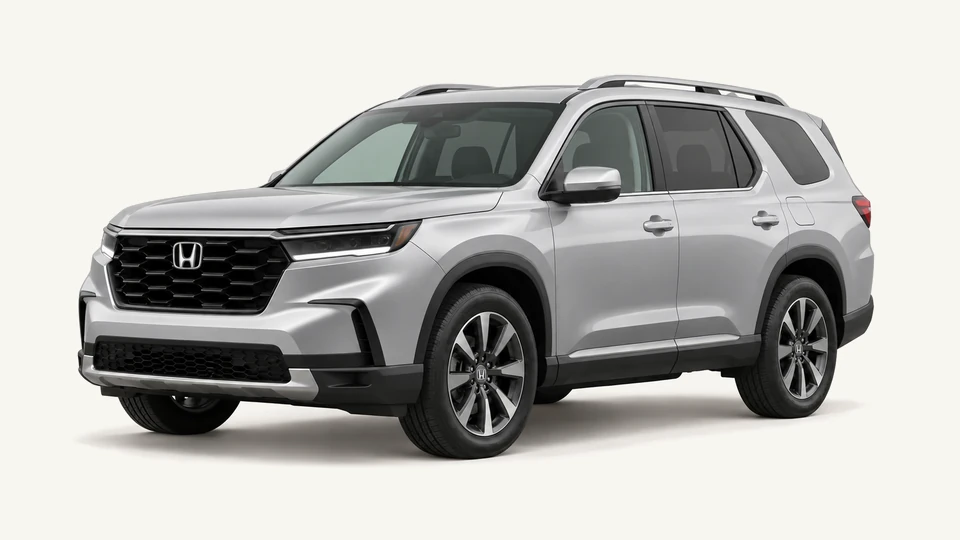
Should You Buy the 2025 Honda Pilot?
It is too early to say for sure. We give a final score after 36 months of complaints. So far the 2025 Honda Pilot has a provisional score of 62, likely between 59 and 66. That puts it in the middle third of the 2025 vehicles we can compare.
The 2024 Pilot, from the same generation, scored 62 and rated Caution. That is a useful guide, not a guarantee.
The most reported problem is the steering, mostly unusual noises (39 of 197 complaints). Owners also complain about automatic emergency braking and the brakes. 90 of the 197 complaints describe a serious outcome, such as a crash, a fire, an injury or stalling while driving.
It has 4 recalls. NHTSA rates it 5 out of 5 stars overall in crash tests.
Before you buy, check that the recalls were done and get an independent inspection. The full checklist is at the end of this page.
Pros
- No do-not-drive or park-outside recalls
- 5-star NHTSA overall crash rating
Cons
- Steering: unusual noises39 complaints
- Automatic emergency braking: hard braking with nothing ahead31 complaints
- Brakes: loss of braking13 complaints
Why There Is No Final Score Yet
Provisional score 62, likely between 59 and 66
It is based on complaints in its first 26 months, compared with the average car at the same age. It sits in the middle third of the 24 model-year 2025 vehicles we can compare so far. The final score and rating come at 36 months.
It is the same generation as the 2024 Pilot, which scored 62 and rated Caution. That is a useful guide, not a guarantee.
What Owners Report
We read all 197 complaints filed with NHTSA for the 2025 Honda Pilot, one by one, and grouped them by the problem they describe. The most reported problems come first.
Steering: unusual noises
39 complaints (20%)
Unusual noises, a feature that stopped working and locking up. 22 of these 39 complaints describe a serious outcome, most often loss of steering control. In 8 complaints, the dealer could not find or fix the problem, and in 7 it came back after a repair. Median mileage when it started: about 6,000 miles.
Automatic emergency braking: hard braking with nothing ahead
31 complaints (16%)
Hard braking with nothing ahead, the system not working when needed and warning lights. 24 of these 31 complaints describe a serious outcome, most often sudden braking. In 8 complaints, the dealer could not find or fix the problem. Median mileage when it started: about 18,000 miles.
Brakes: loss of braking
13 complaints (7%)
Loss of braking, unusual noises and vibration or shudder. 5 of these 13 complaints describe a serious outcome, most often a crash. Median mileage when it started: about 6,000 miles.
Several warning lights at once
13 complaints (7%)
Warning lights. Median mileage when it started: about 10,000 miles.
Adaptive cruise control: works on and off
12 complaints (6%)
Problems that come and go, hard braking with nothing ahead and a feature that stopped working. 2 of these 12 complaints describe a serious outcome, most often sudden braking. In 3 complaints, the dealer could not find or fix the problem.
Driver-assist camera and radar: warning lights
10 complaints (5%)
Warning lights, problems that come and go and a feature that stopped working. Median mileage when it started: about 1,000 miles.
Transmission: harsh or delayed shifts
9 complaints (5%)
Harsh or delayed shifts. 2 of these 9 complaints describe a serious outcome.
Seat belts: stopped working
8 complaints (4%)
A feature that stopped working, false unbuckled warnings and the system not working when needed.
Unintended acceleration (cause not stated)
8 complaints (4%)
Sudden acceleration. 6 of these 8 complaints describe a serious outcome, most often sudden acceleration or braking.
Engine: stalling
7 complaints (4%)
Stalling, a failure and a loss of power. 4 of these 7 complaints describe a serious outcome, most often stalling or losing power while driving.
Stall (cause not stated)
7 complaints (4%)
Stalling. All 7 describe a serious outcome, most often stalling or losing power while driving. In 4 complaints, the dealer could not find or fix the problem.
Windshield: shattering or cracking
7 complaints (4%)
Shattering or cracking and optical distortion. In 3 complaints, the problem came back after a repair.
Sunroof glass (shattered): shattering or cracking
6 complaints (3%)
Shattering or cracking. 1 of these 6 complaints describes a serious outcome: an injury.
AWD or rear differential: stopped working
5 complaints (3%)
A feature that stopped working and warning lights. Median mileage when it started: about 15,000 miles.
Loss of power (cause not stated)
4 complaints (2%)
A loss of power and reduced power or limp mode. 2 of these 4 complaints describe a serious outcome, most often stalling or losing power while driving.
Show 23 more problems
Poor acceleration (cause not stated)
4 complaints (2%)
Hesitation and surging. 1 of these 4 complaints describes a serious outcome: stalling or losing power while driving. Median mileage when it started: about 4,000 miles.
Rearview camera: stopped working
4 complaints (2%)
A feature that stopped working, problems that come and go and poor image resolution at night. 1 of these 4 complaints describes a serious outcome.
12V battery failure
3 complaints (2%)
A failure that needed a new part.
A/C: stopped working
3 complaints (2%)
A feature that stopped working and weak cooling.
A/C compressor failure
3 complaints (2%)
A failure and locking up.
Airbag warning light
3 complaints (2%)
Warning lights.
Instrument cluster: wrong readings
3 complaints (2%)
Wrong readings, a feature that stopped working and stuck 25 mph display.
Key fob: works on and off
3 complaints (2%)
Problems that come and go and a feature that stopped working.
Lane keeping assist: works on and off
3 complaints (2%)
Problems that come and go, a feature that stopped working and pulling or wandering. 1 of these 3 complaints describes a serious outcome.
Parking sensors: the system not working when needed
3 complaints (2%)
The system not working when needed and parts breaking or coming apart.
Phone and navigation: works on and off
3 complaints (2%)
Problems that come and go.
Car not starting (cause not stated)
3 complaints (2%)
The car not starting. All 3 describe a serious outcome, most often a car that would not start.
Shifter or park: shifts into reverse/neutral by itself
3 complaints (2%)
Shifts into reverse/neutral by itself, failure or loss of drive and shifted into park by itself. All 3 describe a serious outcome, most often a tow.
ABS failure
2 complaints (1%)
A failure that needed a new part and a stored fault code.
Brake power assist: a hard pedal or less assist
2 complaints (1%)
A hard pedal or less assist.
Engine (misfire codes): rough running or misfires
2 complaints (1%)
Rough running or misfires. 1 of these 2 complaints describes a serious outcome: stalling or losing power while driving.
Engine failure
2 complaints (1%)
A failure that needed a new part. Both describe a serious outcome, most often stalling or losing power while driving.
Fuel system: a loss of power
2 complaints (1%)
A loss of power and fuel spits out at shutoff when filling. 1 of these 2 complaints describes a serious outcome: stalling or losing power while driving.
Fumes in cabin (cause not stated)
2 complaints (1%)
A bad smell.
Screen and audio: stopped working
2 complaints (1%)
A feature that stopped working and problems that come and go.
Noise (cause not stated)
2 complaints (1%)
Unusual noises.
Wheel rim: damage
2 complaints (1%)
Damage.
Wiring, fuses or body control module: damage
2 complaints (1%)
Damage and problems that come and go.
Reported Once (38)
Show the 38 problems reported once
- EVAP system: fault code
- Airbags: no deployment in a crash
- Uneven tire wear: out of spec after engine replacement
- Alternator or charging failure
- Body seals (water leak): water leaking in
- Check engine light (cause not stated)
- Control module (unspecified): fault code
- Engine air intake: works on and off
- Engine oil leak
- Exhaust or catalytic converter: a bad smell
- Exterior lights failure
- Forward collision warning: works on and off
- Frame or structure: loose crash bar
- Fuel economy: high fuel use
- Fuel leak
- Ignition or power mode (won't shut off): not shutting off
- Mirrors: parts breaking or coming apart
- Passenger airbag sensor: wrong readings
- Oil pressure: warning lights
- Body panel fit: gaps and overlaps
- Clock spring or steering angle sensor failure
- Cylinder heads failure
- Emission control system: reduced power or limp mode
- Emissions system (unspecified): warning lights
- Engine gasket failure
- Front side window seals: leave moisture and streaks on the glass
- Unnamed system shutdown with braking feel (cause not stated)
- Parking brake: warning lights
- Door lock actuators: stopped working
- Remote start: stopped working
- Road departure mitigation: stopped working
- Side blind zone alert
- Starter failure
- Struts or shocks failure
- Tires: pulling or wandering
- Valve train: rough running or misfires
- Vibration (cause not stated)
- Windshield wipers: blades hit the hood
How the 2025 Honda Pilot Compares With Other Years
The other Pilot years of the 4th generation, 2023 to 2026, and the years just before and after it. When two scores are less than 3.5 points apart, treat them as about the same.
| Year | Rating | Score | Vs average | Per 10k cars | Recalls | Most reported problem |
|---|---|---|---|---|---|---|
| 2026 | Too new | – | – | 6.1 | 1 | Steering: unusual noises |
| 2025 This year | Provisional 62 | – | – | 8.1 | 4 | Steering: unusual noises |
| 2024 | Caution | 62 | 1.8× | 16.2 | 6 | Seat belts: false unbuckled warnings |
| 2023 | Caution | 63 | 1.5× | 18.1 | 5 | Seat belts: warning lights |
| 2022 | Good | 72 | 0.81× | 10.5 | 5 | Automatic emergency braking: hard braking with nothing ahead |
2025 Honda Pilot Recalls
A recall can cover some or all cars of this model year. Look up a specific car by its VIN at NHTSA to see which recalls are still open on it.
Service brakes, hydraulic: pedals and linkages
A brake pedal that shifts out of position can prevent the driver from applying the brakes as intended, increasing the risk of a crash or injury.
NHTSA 25V391000Recall report (PDF)Owner letter (PDF)Issued Jun 12, 2025. By the second quarter of 2026, 90% of the cars in this recall had been fixed.
Seat belts: rear/other
A non-functioning seat belt cannot properly restrain the seat occupant, increasing the risk of injury during a crash.
NHTSA 25V056000Recall report (PDF)Owner letter (PDF)Issued Feb 5, 2025. By the second quarter of 2026, 95% of the cars in this recall had been fixed.
Fuel system, gasoline: fuel injection system
An engine stall or loss of power can increase the risk of a crash or injury.
NHTSA 25V031000Recall report (PDF)Owner letter (PDF)Issued Jan 23, 2025. By the second quarter of 2026, 94% of the cars in this recall had been fixed.
Fuel system, gasoline: filler pipe and cap
A fuel leak in the presence of an ignition source increases the risk of a fire.
NHTSA 24V900000Recall report (PDF)Owner letter (PDF)Issued Nov 27, 2024. By the second quarter of 2026, 93% of the cars in this recall had been fixed.
NHTSA Investigations
Defect investigations by NHTSA that cover this model year, with what they found.
Engines failing to restart after automatic idle stop
Still openNHTSA's engineering analysis, opened in March 2025, looks at engines that fail to restart after automatic idle stop shuts them off at a light. It lists 2016-2025 Pilots and 2018-2025 Odysseys, plus Passports and Ridgelines. Honda issued service bulletins and a 10-year warranty on some parts. Owners still report failures after the fixes. The case is still open.
NHTSA EA25004Opening report (PDF)Open since Mar 26, 2025
NHTSA Crash Test Ratings
NHTSA 5-Star Safety Ratings for this model year. See the 2025 Pilot ratings on NHTSA.gov.
SUV AWD and SUV FWD
Check Before You Buy
A checklist for the 2025 Pilot, from its recalls, Honda's programs and the problems owners report most.
Confirm the Recalls Were Done
Ask the seller for proof that each of these recalls was repaired.
- Service brakes, hydraulic: pedals and linkages NHTSA 25V391000
- Seat belts: rear/other NHTSA 25V056000
- Fuel system, gasoline: fuel injection system NHTSA 25V031000
- Fuel system, gasoline: filler pipe and cap NHTSA 24V900000
On the Test Drive
- Turn the wheel fully left and right, parked and at low speed. Sticking, notches or stiffness are warning signs.
- Watch for sudden braking or steering with nothing ahead, and ask whether the driver-assist software updates were done.
- Brake firmly from a moderate speed. A soft, hard or pulsing pedal, or a brake warning light, is a warning sign.
Ask the Seller
Ask whether any of these were ever repaired, and ask to see the receipts.
- Steering
- Automatic emergency braking
- Brakes
- Also ask for the service records, especially oil changes.
Before You Pay
- Get an independent pre-purchase inspection from a mechanic you choose.
- Decode the VIN to confirm the model year, engine and trim.
- Check the title for salvage, flood or rebuilt branding.
What to do next