2000 Honda Passport Reliability Report
NHTSA data as of Oct 15, 2026Published Oct 23, 2026
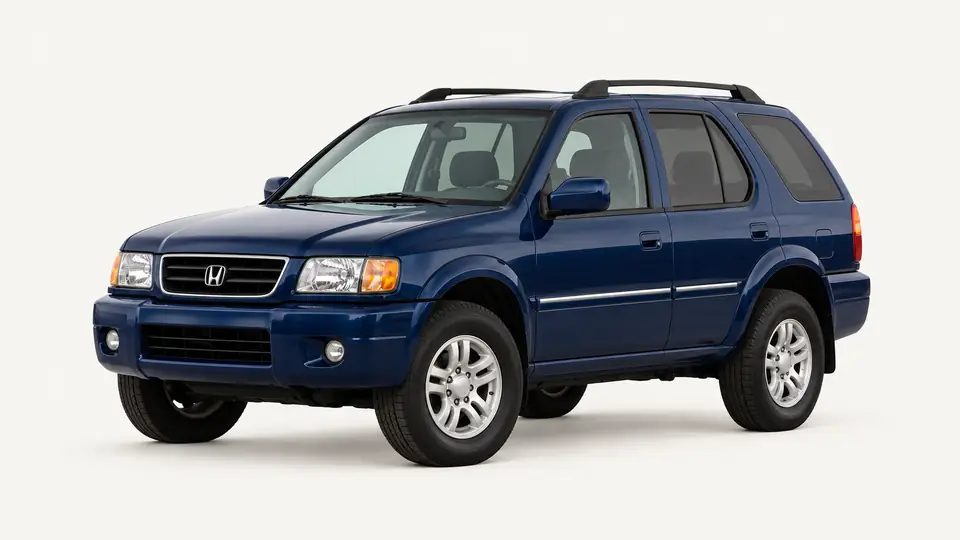
A truck-style, body-on-frame SUV built in Indiana, sharing parts and recalls with the Isuzu Rodeo. Not the same car as the 2019–2026 Passport.
Ranks 2nd of the 3 years of the 2000–2002 Passport we score.
- Owner complaints
- 102
- 4 are recall notices
- Per 10,000 cars
- 47.8
- 20,493 made for the U.S.
- Vs the average car
- 1.5×
- same age, 1× is average
- Serious outcomes
- 38
- crash, fire, injury, stall or tow
- Recalls
- 1
- NHTSA crash rating
- Not rated
- no overall rating before 2011
Should You Buy the 2000 Honda Passport?
Only after careful checks. Our reliability score for the 2000 Honda Passport is 67 out of 100, which rates Caution. Owners reported about 1.5 times as many problems as for the average car of the same age. It ranks 2nd of the 3 years of the 2000–2002 Passport we score.
The most reported problem is the frame and body structure, mostly rust or corrosion (39 of 102 complaints). Owners also complain about the engine and the transmission. 38 of the 102 complaints describe a serious outcome, such as a crash, a fire, an injury or stalling while driving.
It has 1 recall. For comparison, the 2001 scores 62.
Before you buy, check that the recalls were done and get an independent inspection. The full checklist is at the end of this page.
Pros
- No do-not-drive or park-outside recalls
Cons
- About 1.5 times the problems of the average car its age
- Frame or structure: rust or corrosion39 complaints
- Engine: stalling13 complaints
- Transmission failure9 complaints
How the 2000 Passport Earned Its Score
Every model year starts at 100. Each part takes points away when this year has more problems than the average car of the same age. How we score
| Item | Vs average | Points lost |
|---|---|---|
| Starting score | 100 | |
| Serious problems38 complaints · average car: about 24 | 1.5× | −20 |
| Everyday problems60 complaints · average car: about 42 | 1.4× | −9 |
| Problems in the last two years0 complaints · average car: about 0.1 | Not counted | – |
| Recalls1 recall · average car: about 3.3 | 0.58× | −4 |
| Score | 67 |
The last two years are not counted for the 2000 Passport. Honda made 20,493 of them, and at this age an average car made in that number would get only about 0.1 complaints of any kind in two years. We need at least 5 to compare, so we leave this part out. Its 30% goes to serious and everyday problems instead, so they make up 80% of the score rather than 50%.
Each part shows two counts: this year's so far, and what an average car would have at the same age. For complaints, that average car was made in the same number as this one. “Vs average” compares the two counts, but in our scoring system we first add a little to both, so a few complaints cannot swing the result. That is why it is not simply one count divided by the other. The last two years count only complaints about five systems: the engine and fuel system, transmission, brakes, steering, and airbags and seat belts.
What Owners Report
We read all 102 complaints filed with NHTSA for the 2000 Honda Passport, one by one, and grouped them by the problem they describe. The most reported problems come first. A complaint that describes more than one problem is counted under each, so the counts add up to more than 102.
Frame or structure: rust or corrosion
39 complaints (38%)
Rust or corrosion, parts breaking or coming apart and a failure. 20 of these 39 complaints describe a serious outcome, most often a tow. Median mileage when it started: about 121,000 miles.
Engine: stalling
13 complaints (13%)
Stalling, a failure that needed a new part and unusual noises. 9 of these 13 complaints describe a serious outcome, most often stalling or losing power while driving. In 5 complaints, the dealer could not find or fix the problem, and in 5 it came back after a repair. Median mileage when it started: about 84,000 miles.
Transmission failure
9 complaints (9%)
A failure, slipping and changes gears by itself. 7 of these 9 complaints describe a serious outcome, most often a tow. Median mileage when it started: about 56,000 miles.
Fuel gauge or level sensor: wrong readings
5 complaints (5%)
Wrong readings and a failure. Median mileage when it started: about 81,000 miles.
Steering: sticking or stiffness
5 complaints (5%)
Sticking or stiffness, shattering or cracking and a failure. 1 of these 5 complaints describes a serious outcome: a tow. Median mileage when it started: about 121,000 miles.
Ball joints and control arms: parts breaking or coming apart
4 complaints (4%)
Parts breaking or coming apart. All 4 describe a serious outcome, most often a tow. Median mileage when it started: about 128,000 miles.
Brakes: longer stopping distance
4 complaints (4%)
Longer stopping distance, loss of braking and a hard pedal or less assist. 2 of these 4 complaints describe a serious outcome, most often loss of braking. Median mileage when it started: about 120,000 miles.
Seat belts: locking up
4 complaints (4%)
Locking up and early wear.
Frontal airbags: no deployment in a crash
3 complaints (3%)
No deployment in a crash.
Tires failure
3 complaints (3%)
A failure, unusual noises and parts breaking or coming apart.
Unintended acceleration (cause not stated)
3 complaints (3%)
Sudden acceleration. 2 of these 3 complaints describe a serious outcome, most often sudden acceleration or braking.
ABS: the system acting on its own
2 complaints (2%)
The system acting on its own and the system not working when needed.
AWD or rear differential failure
2 complaints (2%)
A failure that needed a new part.
Engine failure
2 complaints (2%)
A failure that needed a new part and the car not starting. Both describe a serious outcome, most often a car that would not start.
Engine oil consumption: burning or using oil
2 complaints (2%)
Burning or using oil.
Show 3 more problems
Engine sensors or computer: fault code
2 complaints (2%)
A stored fault code and a loss of power. 1 of these 2 complaints describes a serious outcome: stalling or losing power while driving.
Sway bar links: parts breaking or coming apart
2 complaints (2%)
Parts breaking or coming apart. 1 of these 2 complaints describes a serious outcome.
Transmission fluid leak
2 complaints (2%)
A leak.
Reported Once (28)
Show the 28 problems reported once
- Uneven tire wear: early wear
- Body seals (water leak): water leaking in
- Check engine light (cause not stated)
- Cooling system: sticking or stiffness
- Several warning lights at once
- Engine air intake: rough running or misfires
- Exhaust or catalytic converter failure
- Exterior trim failure
- Fuel leak
- Screen and audio: works on and off
- Interior trim failure
- Loss of power (cause not stated)
- Manual transmission or clutch failure
- Mirrors: damage
- Noise (cause not stated)
- Flex plate: parts breaking or coming apart
- Front end skipping when stopping (cause not stated)
- Manifold gaskets failure
- Rear end sway (cause not stated)
- Rear wiper: stopped working
- Smoke from front passenger side (cause not stated)
- Smoke while running (cause not stated)
- Suspension: parts breaking or coming apart
- Unidentified part underneath broke (cause not stated)
- Paint and rust: damage
- Shifter or park: stopped working
- Vibration (cause not stated)
- Wiring, fuses or body control module
How the 2000 Honda Passport Compares With Other Years
The other Passport years of the 2nd generation, 2000 to 2002.
| Year | Rating | Score | Vs average | Per 10k cars | Recalls | Most reported problem |
|---|---|---|---|---|---|---|
| 2002 | Good | 70 | 1.0× | 36.7 | 2 | Frame or structure: rust or corrosion |
| 2001 | Caution | 62 | 2.0× | 73.0 | 3 | Frame or structure: rust or corrosion |
| 2000 This year | Caution | 67 | 1.5× | 47.8 | 1 | Frame or structure: rust or corrosion |
2000 Honda Passport Recalls
One recall covers the 2000 Honda Passport. It was issued in September 2010: “Rear Suspension Lower Link Brackets (ISUZU MANUFACTURING SERVICES OF AMERICA).” A VIN check at NHTSA shows whether it is still open on a given car.
Rear Suspension Lower Link Brackets (ISUZU MANUFACTURING SERVICES OF AMERICA)
Excessive corrosion may result in the left or right rear suspension lower link bracket becoming detached from the frame, which can affect vehicle handling and potentially cause a crash.
NHTSA 10V436000Owner letter (PDF)Issued Sep 22, 2010.
2000 Honda Passport NHTSA Investigations
NHTSA has opened two investigations that cover the 2000 Honda Passport. Two led to a recall.
Rear suspension lower link separating from the frame in Passports
Led to a recallNHTSA's preliminary evaluation looked at rear suspension lower links separating from the frame on 1998-2002 Passports. Isuzu said corrosion builds slowly and gives warning. NHTSA counted 60 reports, including 1 alleging a crash and 7 a loss of control, most with no warning. It upgraded the case to engineering analysis EA09-018 in December 2009. Its record links recall 10V-436.
NHTSA PE09030Opening report (PDF)Closing report (PDF)Jun 16, 2009 to Dec 8, 2009
Road deicing corrosion detaching a rear suspension link bracket
Led to a recallNHTSA's engineering analysis covered 1998-2002 Honda Passports and Isuzu Rodeos. Road deicing materials could corrode a rear suspension lower link bracket until it came off the frame. That could affect handling and cause a crash. Isuzu recalled about 120,000 vehicles bought or driven in 21 states and Washington DC, under recall 10V-436. NHTSA closed the case in October 2010.
NHTSA EA09018Opening report (PDF)Closing report (PDF)Dec 7, 2009 to Oct 15, 2010
NHTSA Crash Test Ratings
NHTSA gave the 2000 Passport no overall, frontal or side rating. It did rate each seat in those tests and lists the seat ratings under Rating Breakdown on its page. We show them the same way below. These tests are from before 2011, so the stars are not comparable with ratings for 2011 and newer models. See the 2000 Passport ratings on NHTSA.gov.
4-door 4x4
Check Before You Buy
A checklist for the 2000 Passport, from its recall and the problems owners report most.
Confirm the Recalls Were Done
Ask the seller for proof that each of these recalls was repaired.
- Rear Suspension Lower Link Brackets (ISUZU MANUFACTURING SERVICES OF AMERICA) NHTSA 10V436000
On the Test Drive
- Accelerate gently from a stop and again at 20 to 40 mph. Shudder, slipping or harsh shifts are warning signs. Ask for the transmission fluid records.
- Turn the wheel fully left and right, parked and at low speed. Sticking, notches or stiffness are warning signs.
- Look for uneven tire wear and listen for clunks or humming that changes with speed.
Ask the Seller
Ask whether any of these were ever repaired, and ask to see the receipts.
- Frame and body structure
- Engine
- Transmission
- Also ask for the service records, especially oil changes and transmission fluid changes.
Before You Pay
- Get an independent pre-purchase inspection from a mechanic you choose.
- Decode the VIN to confirm the model year, engine and trim.
- Check the title for salvage, flood or rebuilt branding.
What to do next