2015 Honda Odyssey Reliability Report
NHTSA data as of Sep 17, 2026Published Oct 15, 2026
Ranks 4th of 25 Odyssey years we score.
- Owner complaints
- 206
- 8 are recall notices
- Per 10,000 cars
- 15.2
- 130,240 made for the U.S.
- Vs the average car
- 0.44×
- same age, 1× is average
- Serious outcomes
- 66
- crash, fire, injury, stall or tow
- Recalls
- 6
- NHTSA crash rating
- 5★
- overall, out of 5
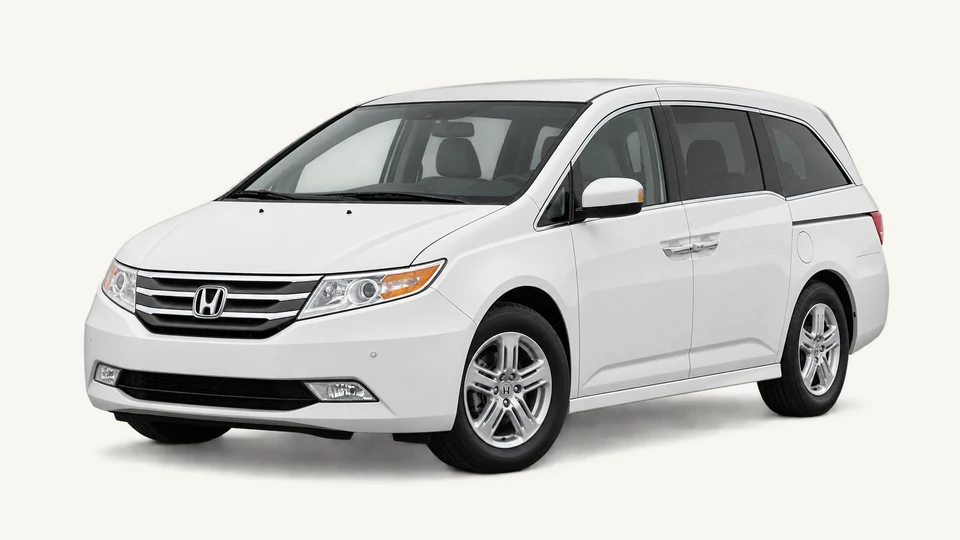
Should You Buy the 2015 Honda Odyssey?
Yes, with the usual checks. Our reliability score for the 2015 Honda Odyssey is 77 out of 100, which rates Good. Owners reported about half as many problems as for the average car of the same age. It ranks 4th of the 25 Odyssey years we score.
The most reported problem is the transmission, mostly harsh or delayed shifts (29 of 206 complaints). Owners also complain about piston rings or cylinders and the ignition coil or spark plug. 66 of the 206 complaints describe a serious outcome, such as a crash, a fire, an injury or stalling while driving.
It has 6 recalls. NHTSA rates it 5 out of 5 stars overall in crash tests. For comparison, the 2014 scores 76 and the 2016 scores 74.
Before you buy, check that the recalls were done and get an independent inspection. The full checklist is at the end of this page.
Pros
- Good reliability score of 77
- About half the problems of the average car its age
- No do-not-drive or park-outside recalls
- 5-star NHTSA overall crash rating
Cons
- Transmission: harsh or delayed shifts29 complaints
- Piston rings: burning or using oil20 complaints
- Ignition coils or spark plugs: rough running or misfires18 complaints
How the 2015 Odyssey Earned Its Score
Every model year starts at 100. Each part takes points away when this year has more problems than the average car of the same age. How we score
| Item | Vs average | Points lost |
|---|---|---|
| Starting score | 100 | |
| Serious problems | 0.40× | −6 |
| Everyday problems | 0.55× | −3 |
| Problems in the last two years | 0.74× | −8 |
| Recalls | 1.0× | −6 |
| Score | 77 |
What Owners Report
We read all 206 complaints filed with NHTSA for the 2015 Honda Odyssey, one by one, and grouped them by the problem they describe. The most reported problems come first.
Transmission: harsh or delayed shifts
29 complaints (14%)
Harsh or delayed shifts, vibration or shudder and slipping. 6 of these 29 complaints describe a serious outcome, most often a tow. In 8 complaints, the dealer could not find or fix the problem, and in 3 it came back after a repair. Median mileage when it started: about 40,000 miles.
Piston rings: burning or using oil
20 complaints (10%)
Burning or using oil, a failure and early wear. 18 of these 20 complaints describe a serious outcome, most often stalling or losing power while driving. In 4 complaints, the problem came back after a repair. Median mileage when it started: about 113,000 miles.
Ignition coils or spark plugs: rough running or misfires
18 complaints (9%)
Rough running or misfires, damage and oil fouled. 2 of these 18 complaints describe a serious outcome, most often stalling or losing power while driving. Median mileage when it started: about 92,000 miles.
Sliding doors: parts breaking or coming apart
17 complaints (8%)
Parts breaking or coming apart, not closing or latching and not opening or unlocking. 4 of these 17 complaints describe a serious outcome, most often an injury. Median mileage when it started: about 40,000 miles.
Sunroof glass (shattered): shattering or cracking
15 complaints (7%)
Shattering or cracking. Median mileage when it started: about 41,000 miles.
Brakes: loss of braking
9 complaints (4%)
Loss of braking, vibration or shudder and soft or sinking brake pedal. 3 of these 9 complaints describe a serious outcome, most often loss of braking. Median mileage when it started: about 7,000 miles.
Engine (misfire codes): rough running or misfires
9 complaints (4%)
Rough running or misfires and a stored fault code. Median mileage when it started: about 95,000 miles.
Seats: not closing or latching
7 complaints (3%)
Not closing or latching, parts breaking or coming apart and unstable while driving. 1 of these 7 complaints describes a serious outcome: an airbag problem. Median mileage when it started: about 40,000 miles.
Airbags: no deployment in a crash
6 complaints (3%)
No deployment in a crash and deployment with no crash. 2 of these 6 complaints describe a serious outcome, most often an airbag problem. Median mileage when it started: about 159,000 miles.
Alternator or charging failure
6 complaints (3%)
A failure and contaminated by oil. 4 of these 6 complaints describe a serious outcome, most often being stranded.
Engine: stalling
6 complaints (3%)
Stalling, sudden acceleration and a fire. 4 of these 6 complaints describe a serious outcome, most often stalling or losing power while driving. Median mileage when it started: about 25,000 miles.
Unintended acceleration (cause not stated)
6 complaints (3%)
Sudden acceleration and surging. 3 of these 6 complaints describe a serious outcome, most often sudden acceleration or braking. Median mileage when it started: about 21,000 miles.
Vibration (cause not stated)
5 complaints (2%)
Vibration or shudder. In 3 complaints, the dealer could not find or fix the problem. Median mileage when it started: about 4,000 miles.
Headlights: stopped working
4 complaints (2%)
A feature that stopped working, short low-beam reach with sharp dark cutoff and low-beam pattern, very little light reaches the road. In 3 complaints, the dealer could not find or fix the problem. Median mileage when it started: about 2,000 miles.
Seat belts: stopped working
4 complaints (2%)
A feature that stopped working, locking up and not releasing. 2 of these 4 complaints describe a serious outcome, most often an injury.
Show 21 more problems
Door latches: not opening or unlocking
3 complaints (1%)
Not opening or unlocking and opened during the collision.
Frontal airbags: unusual noises
3 complaints (1%)
Unusual noises, deployment with no crash and no deployment in a crash.
Spool valve: a leak
3 complaints (1%)
A leak.
Paint and rust: paint peeling
3 complaints (1%)
Paint peeling.
Side or curtain airbags: deployment with no crash
3 complaints (1%)
Deployment with no crash and no deployment in a crash. 1 of these 3 complaints describes a serious outcome: an airbag problem. Median mileage when it started: about 54,000 miles.
Car not starting (cause not stated)
3 complaints (1%)
The car not starting and problems that come and go. 2 of these 3 complaints describe a serious outcome, most often a car that would not start. Median mileage when it started: about 5,000 miles.
Steering: a leak
3 complaints (1%)
A leak and unusual noises. 1 of these 3 complaints describes a serious outcome.
Tires: tire blowout
3 complaints (1%)
Tire blowout and parts breaking or coming apart. 2 of these 3 complaints describe a serious outcome, most often being stranded. Median mileage when it started: about 23,000 miles.
Variable cylinder management (VCM): oil control problem
3 complaints (1%)
Oil control problem, a stored fault code and a failure.
Airbag warning light
2 complaints (under 1%)
Warning lights.
Engine oil leak
2 complaints (under 1%)
A leak.
Forward collision warning: stopped working
2 complaints (under 1%)
A feature that stopped working.
Fuel pump failure
2 complaints (under 1%)
A failure that needed a new part. 1 of these 2 complaints describes a serious outcome: stalling or losing power while driving.
Lane keeping assist: stopped working
2 complaints (under 1%)
A feature that stopped working.
Loss of power (cause not stated)
2 complaints (under 1%)
A loss of power. 1 of these 2 complaints describes a serious outcome: stalling or losing power while driving.
Stability control (VSA): the system acting on its own
2 complaints (under 1%)
The system acting on its own and a feature that stopped working.
Stall (cause not stated)
2 complaints (under 1%)
Stalling and hesitation. 1 of these 2 complaints describes a serious outcome: stalling or losing power while driving.
Torque converter failure
2 complaints (under 1%)
A failure that needed a new part.
Transmission computer: vibration or shudder
2 complaints (under 1%)
Vibration or shudder and harsh or delayed shifts.
Windshield wipers: stopped working
2 complaints (under 1%)
A feature that stopped working. 1 of these 2 complaints describes a serious outcome: loss of visibility.
Wiring, fuses or body control module: damage
2 complaints (under 1%)
Damage.
Reported Once (43)
Show the 43 problems reported once
- 12V battery: draining the battery
- A/C condenser: stopped working
- EVAP system failure
- Battery drain: draining the battery
- Body seals (water leak): water leaking in
- Coil spring: parts breaking or coming apart
- Control arm bushings: parts breaking or coming apart
- Several warning lights at once
- Defroster: stopped working
- CV axles failure
- Engine mounts: weakened
- Engine oil consumption: burning or using oil
- Frame or structure: unusual noises
- Fuel system: unusual noises
- Fuel leak
- Fumes in cabin (cause not stated)
- Horn: the system acting on its own
- Ignition or push-button start: the car not starting
- Instrument cluster: flashes across the screen
- Key fob: the car not starting
- Noise (cause not stated)
- MICU failure
- PGM-FI software failure
- Back door (liftgate) open sensor: wrong readings
- Cylinder head components: damage
- Door panel failure
- Fire (origin not stated) (cause not stated)
- Firewall (named as the cause by the fire department)
- Hood switch (security alarm): the system acting on its own
- Hot surface at right rear seat (cause not stated)
- Passenger side mirror camera: works on and off
- Piston valves: a leak
- Rear hatch glass: shattering or cracking
- Suspension: unusual noises
- Throttle control: unusual noises
- Wheel stud: parts breaking or coming apart
- Poor acceleration (cause not stated)
- Door lock actuators: stopped working
- Rearview camera: works on and off
- Struts or shocks: parts breaking or coming apart
- Taillights or brake lights: stopped working
- Tire pressure monitoring: warning lights
- Wheel bearings failure
How the 2015 Honda Odyssey Compares With Other Years
The other Odyssey years of the 4th generation, 2011 to 2017, and the years just before and after it. When two scores are less than 3.5 points apart, treat them as about the same.
| Year | Rating | Score | Vs average | Per 10k cars | Recalls | Most reported problem |
|---|---|---|---|---|---|---|
| 2018 | Avoid | 54 | 3.1× | 85.3 | 16 | Driver-assist camera and radar failure |
| 2017 | Good | 77 | 0.57× | 13.6 | 2 | Ignition coils or spark plugs failure |
| 2016 | Good | 74 | 0.57× | 17.8 | 6 | Piston rings failure |
| 2015 This year | Good | 77 | 0.44× | 15.2 | 6 | Transmission: harsh or delayed shifts |
| 2014 | Good | 76 | 0.53× | 20.7 | 5 | Transmission: harsh or delayed shifts |
| 2013 | Good | 73 | 0.59× | 21.9 | 6 | Brakes: vibration or shudder |
| 2012 | Excellent | 80 | 0.43× | 16.4 | 5 | Brakes: vibration or shudder |
| 2011 | Good | 78 | 0.54× | 21.2 | 5 | 12V battery: warning lights |
| 2010 | Good | 78 | 0.54× | 21.2 | 1 | Sliding doors: parts breaking or coming apart |
2015 Honda Odyssey Recalls
A recall can cover some or all cars of this model year. Look up a specific car by its VIN at NHTSA to see which recalls are still open on it.
Equipment adaptive/mobility: latch/anchor (Rollx Vans)
An unsecured wheelchair can move during transit, increasing the risk of injury.
NHTSA 25V876000Recall report (PDF)Owner letter (PDF)Issued Dec 17, 2025. By the second quarter of 2026, 2% of the cars in this recall had been fixed.
Fuel system, gasoline: fuel pump
Fuel pump failure can cause an engine stall while driving, increasing the risk of a crash.
NHTSA 23V858000Recall report (PDF)Owner letter (PDF)Issued Dec 18, 2023. By the second quarter of 2026, 73% of the cars in this recall had been fixed.
Seats: mid/rear assembly
An unlocked second row left outboard seatback increases the risk of injury to the seat occupant during a crash.
NHTSA 18V170000Recall report (PDF)Owner letter (PDF)Issued Mar 13, 2018. By the third quarter of 2019, 83% of the cars in this recall had been fixed.
Seats: mid/rear assembly
If the seat tips forward during braking, it can increase the risk of injury.
NHTSA 17V725000Recall report (PDF)Owner letter (PDF)Issued Nov 17, 2017. By the third quarter of 2019, 79% of the cars in this recall had been fixed.
Seats: mid/rear assembly
An unlocked second row outboard seat increases the risk of injury to the seat occupant during a crash.
NHTSA 16V933000Recall report (PDF)Owner letter (PDF)Issued Dec 27, 2016. By the third quarter of 2018, 80% of the cars in this recall had been fixed.
Fuel system, gasoline: tank assembly
A fuel leak in the presence of an ignition source may result in a fire.
NHTSA 16V417000Recall report (PDF)Owner letter (PDF)Issued Jun 9, 2016. By the fourth quarter of 2017, 100% of the cars in this recall had been fixed.
NHTSA Investigations
Defect investigations by NHTSA that cover this model year, with what they found.
Petition on Odyssey air bags deploying without a crash
Still openA petition from May 2026 asks NHTSA to investigate air bags deploying by mistake in 2011-2017 Odysseys. It says they can deploy without an impact or rollover, and that fault codes and recorded data conflict. It cites 10 complaints. NHTSA opened a defect petition in July 2026 to decide whether to grant or deny it. It is still open.
NHTSA DP26005Opening report (PDF)Closing report (PDF)Open since Jul 13, 2026
NHTSA Crash Test Ratings
NHTSA 5-Star Safety Ratings for this model year. See the 2015 Odyssey ratings on NHTSA.gov.
Van FWD
Check Before You Buy
A checklist for the 2015 Odyssey, from its recalls, Honda's programs and the problems owners report most.
Confirm the Recalls Were Done
Ask the seller for proof that each of these recalls was repaired.
- Equipment adaptive/mobility: latch/anchor (Rollx Vans) NHTSA 25V876000
- Fuel system, gasoline: fuel pump NHTSA 23V858000
- Seats: mid/rear assembly NHTSA 18V170000
- Seats: mid/rear assembly NHTSA 17V725000
- Seats: mid/rear assembly NHTSA 16V933000
- Look up the VIN at NHTSA to see all 6 recalls and which are still open.
On the Test Drive
- Accelerate gently from a stop and again at 20 to 40 mph. Shudder, slipping or harsh shifts are warning signs. Ask for the transmission fluid records.
- Ask how often oil is added between changes, and watch for blue smoke at startup.
- Have the engine scanned for stored misfire codes. A rough idle or a flashing check-engine light is a warning sign.
Ask the Seller
Ask whether any of these were ever repaired, and ask to see the receipts.
- Transmission
- Piston rings or cylinders
- Ignition coil or spark plug
- Also ask for the service records, especially oil changes and transmission fluid changes.
Before You Pay
- Get an independent pre-purchase inspection from a mechanic you choose.
- Decode the VIN to confirm the model year, engine and trim.
- Check the title for salvage, flood or rebuilt branding.
What to do next