2009 Honda Element Reliability Report
NHTSA data as of Oct 15, 2026Published Oct 23, 2026
Ranks 4th of 9 Element years we score.
- Owner complaints
- 31
- 4 are recall notices
- Per 10,000 cars
- 24.3
- 11,129 made for the U.S.
- Vs the average car
- 0.72×
- same age, 1× is average
- Serious outcomes
- 11
- crash, fire, injury, stall or tow
- Recalls
- 8
- NHTSA crash rating
- Not rated
- no overall rating before 2011
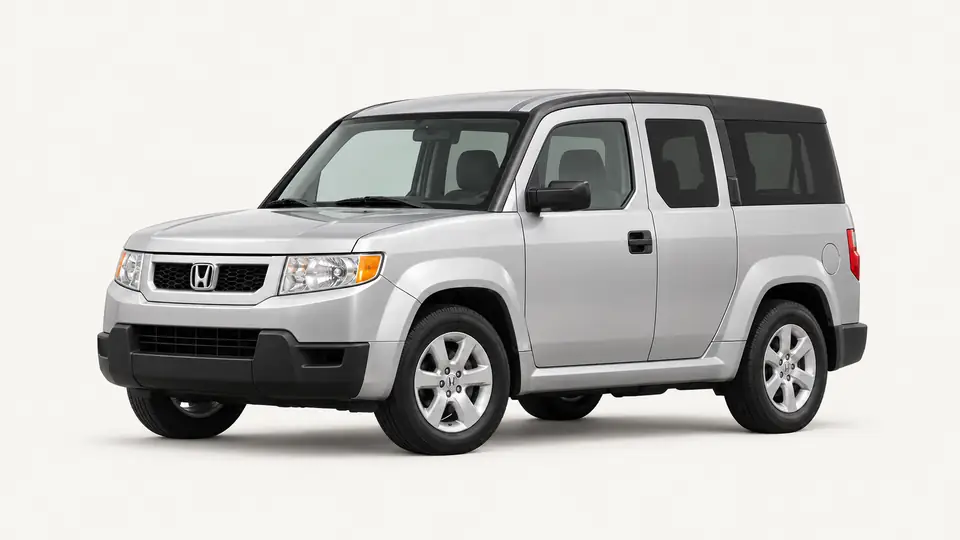
Should You Buy the 2009 Honda Element?
Yes, with the usual checks. Our reliability score for the 2009 Honda Element is 72 out of 100, which rates Good. Owners reported fewer problems than for the average car of the same age. It ranks 4th of the 9 Element years we score.
The most reported problem is the brakes, mostly soft pedal (7 of 31 complaints). Owners also complain about the frame and body structure and ball joints and control arms. 11 of the 31 complaints describe a serious outcome, such as a crash, a fire, an injury or stalling while driving.
It has 8 recalls. For comparison, the 2008 scores 75 and the 2010 scores 79.
Before you buy, check that the recalls were done and get an independent inspection. The full checklist is at the end of this page.
Pros
- Good reliability score of 72
- Fewer problems than the average car its age
- No do-not-drive or park-outside recalls
Cons
- Brakes: soft pedal7 complaints
- Frame or structure: rust or corrosion6 complaints
- Ball joints and control arms: parts breaking or coming apart5 complaints
How the 2009 Element Earned Its Score
Every model year starts at 100. Each part takes points away when this year has more problems than the average car of the same age. How we score
| Item | Vs average | Points lost |
|---|---|---|
| Starting score | 100 | |
| Serious problems11 complaints · average car: about 16 | 0.72× | −14 |
| Everyday problems16 complaints · average car: about 24 | 0.70× | −6 |
| Problems in the last two years2 complaints · average car: about 0.5 | Not counted | – |
| Recalls8 recalls · average car: about 4.1 | 1.6× | −8 |
| Score | 72 |
The last two years are not counted for the 2009 Element. Honda made 11,129 of them, and at this age an average car made in that number would get only about 0.9 complaints of any kind in two years. We need at least 5 to compare, so we leave this part out. Its 30% goes to serious and everyday problems instead, so they make up 80% of the score rather than 50%.
Each part shows two counts: this year's so far, and what an average car would have at the same age. For complaints, that average car was made in the same number as this one. “Vs average” compares the two counts, but in our scoring system we first add a little to both, so a few complaints cannot swing the result. That is why it is not simply one count divided by the other. The last two years count only complaints about five systems: the engine and fuel system, transmission, brakes, steering, and airbags and seat belts.
What Owners Report
We read all 31 complaints filed with NHTSA for the 2009 Honda Element, one by one, and grouped them by the problem they describe. The most reported problems come first. A complaint that describes more than one problem is counted under each, so the counts add up to more than 31.
Brakes: soft pedal
7 complaints (23%)
Soft pedal and loss of braking. 1 of these 7 complaints describes a serious outcome: a crash. Median mileage when it started: about 22,000 miles.
Frame or structure: rust or corrosion
6 complaints (19%)
Rust or corrosion and parts breaking or coming apart. 4 of these 6 complaints describe a serious outcome, most often a tow.
Ball joints and control arms: parts breaking or coming apart
5 complaints (16%)
Parts breaking or coming apart, rust or corrosion and damage. 2 of these 5 complaints describe a serious outcome, most often a tow. Median mileage when it started: about 125,000 miles.
Airbags: injurious deployment
2 complaints (6%)
Injurious deployment and no deployment in a crash. 1 of these 2 complaints describes a serious outcome: an injury.
Reported Once (13)
Show the 13 problems reported once
- A/C condenser: damage
- ABS failure
- Brake calipers: locking up
- Engine sensors or computer: reduced power or limp mode
- Frontal airbags: no deployment in a crash
- Instrument cluster: parts breaking or coming apart
- Interior trim: parts breaking or coming apart
- Interim shaft bearing (cause not stated)
- Paint and rust: rust or corrosion
- Steering: vibration or shudder
- Tire pressure monitoring: warning lights
- Unintended acceleration (cause not stated)
- Windshield: shattering or cracking
How the 2009 Honda Element Compares With Other Years
Every Element year is here: the Element was made in one generation, 2003 to 2011.
| Year | Rating | Score | Vs average | Per 10k cars | Recalls | Most reported problem |
|---|---|---|---|---|---|---|
| 2011 | Excellent | 88 | 0.17× | 5.2 | 10 | – |
| 2010 | Good | 79 | 0.40× | 13.9 | 10 | Brakes: loss of braking |
| 2009 This year | Good | 72 | 0.72× | 24.3 | 8 | Brakes: soft pedal |
| 2008 | Good | 75 | 0.53× | 22.6 | 12 | Brakes: soft pedal |
| 2007 | Good | 72 | 0.67× | 27.6 | 10 | Instrument cluster: parts breaking or coming apart |
| 2006 | Good | 70 | 0.83× | 24.8 | 9 | Side or curtain airbags: deployment with no crash |
| 2005 | Good | 70 | 0.90× | 26.5 | 7 | Frontal airbags: deployment with no crash |
| 2004 | Caution | 67 | 1.1× | 46.6 | 9 | Windshield: shattering or cracking |
| 2003 | Caution | 66 | 1.2× | 52.3 | 10 | Windshield: shattering or cracking |
2009 Honda Element Recalls
Eight recalls cover the 2009 Honda Element. The most recent was issued in June 2019: “Driver Frontal Air Bag Inflator May Explode.” A VIN check at NHTSA shows which are still open on a given car.
Driver Frontal Air Bag Inflator May Explode, June 2019
An inflator explosion may result in sharp metal fragments striking the driver or other occupants resulting in serious injury or death.
NHTSA 19V499000Recall report (PDF)Owner letter (PDF)Issued Jun 27, 2019. By the fourth quarter of 2020, 22% of the cars in this recall had been fixed.
Passenger Frontal Air Bag Inflator May Explode, June 2019
An inflator explosion may result in sharp metal fragments striking the driver or other occupants resulting in serious injury or death.
NHTSA 19V501000Recall report (PDF)Owner letter (PDF)Issued Jun 27, 2019. By the fourth quarter of 2020, 42% of the cars in this recall had been fixed.
Driver Frontal Air Bag Inflator May Explode, March 2019
An explosion of an inflator within the driver frontal air bag module may result in sharp metal fragments striking the driver, front seat passenger or other occupants resulting in serious injury or death.
NHTSA 19V182000Recall report (PDF)Owner letter (PDF)Issued Mar 6, 2019. By the third quarter of 2020, 49% of the cars in this recall had been fixed.
Passenger Frontal Air Bag Inflator May Explode, January 2018
An inflator explosion may result in sharp metal fragments striking the driver or other occupants resulting in serious injury or death.
NHTSA 18V041000Recall report (PDF)Owner letter (PDF)Issued Jan 9, 2018. By the second quarter of 2019, 79% of the cars in this recall had been fixed.
Passenger Frontal Air Bag Inflator May Rupture, January 2017
An inflator rupture may result in metal fragments striking the vehicle occupants resulting in serious injury or death.
NHTSA 17V029000Recall report (PDF)Owner letter (PDF)Issued Jan 10, 2017. By the second quarter of 2018, 68% of the cars in this recall had been fixed.
Passenger Frontal Air Bag Inflator May Rupture, May 2016
An inflator rupture may result in metal fragments striking the vehicle occupants resulting in serious injury or death.
NHTSA 16V344000Recall report (PDF)Owner letter (PDF)Issued May 23, 2016. By the third quarter of 2017, 58% of the cars in this recall had been fixed.
Show 2 more recalls
Driver's Frontal Air Bag May Rupture
In the event of a crash necessitating deployment of the driver's frontal air bag, the inflator could rupture with metal fragments striking the driver or other occupants resulting in serious injury or death.
NHTSA 15V320000Recall report (PDF)Owner letter (PDF)Issued May 28, 2015. By the fourth quarter of 2017, 68% of the cars in this recall had been fixed.
Accessory Trailer Hitch Wiring Harness
Without trailer turn signal illumination, the driver's intent is not communicated, potentially increasing the risk of a crash.
NHTSA 12V436000Owner letter (PDF)Issued Sep 5, 2012.
2009 Honda Element Warranty Extensions and Programs
Honda has six customer support programs for the 2009 Honda Element, separate from its recalls. All six are for problems with the airbags. Two have ended. Whether one applies to a car depends on its VIN, which a Honda dealer can check.
- Customer support programHonda 18-053, 20-015 and 18-056
Front passenger's airbag inflator
3 programs with the same terms. Which one applies depends on the VIN.
- The problem:
- The front passenger's airbag inflator can be faulty, and the airbag warning light comes on.
- The fix:
- A Honda dealer replaces the front passenger's airbag inflator for free.
- Who qualifies:
- The airbag warning light must be on. A Honda dealer test must show the inflator is faulty. Only replacement inflators that fail later are covered. Open inflator recalls must be done first. Salvage or branded titles are not covered.
- Coverage:
- 18-053: Covered until January 31, 2027.
- 20-015: Covered until January 31, 2030.
- 18-056: Covered until January 31, 2028.
Another program for the same problem, Honda 18-050, has ended.
Bulletin 18-053 (PDF)Bulletin 20-015 (PDF)Bulletin 18-056 (PDF)
- Customer support programHonda 20-010
Driver's airbag inflator
- The problem:
- The driver's airbag inflator can be faulty, and the airbag warning light comes on.
- The fix:
- A Honda dealer replaces the driver's airbag inflator for free.
- Who qualifies:
- The airbag warning light must be on. A Honda dealer test must show the inflator is faulty. Only replacement inflators that fail later are covered. Open inflator recalls must be done first. Salvage or branded titles are not covered.
- Coverage:
- Covered until January 31, 2030.
Another program for the same problem, Honda 18-047, has ended.
Honda's bulletin (PDF)
2009 Honda Element NHTSA Investigations
NHTSA has opened three investigations that cover the 2009 Honda Element. Two are still open and one led to a recall.
Takata air bag inflators rupturing, mostly in humid areas
Led to a recallNHTSA's preliminary evaluation began in June 2014 after six Takata air bag inflator ruptures. It covered Honda Accord, Civic, CR-V, Odyssey and Pilot models from 2001 to 2007, among others. All 10 makers started regional recalls within about two weeks. NHTSA asked them to widen the recalls. It closed in March 2015 and moved to engineering analysis EA15-001.
NHTSA PE14016Opening report (PDF)Closing report (PDF)Jun 11, 2014 to Mar 2, 2015
Takata air bag inflator ruptures across all makers
Still openNHTSA's engineering analysis, opened in February 2015, covers Takata air bag inflators that can rupture. It includes Honda Accord, Civic, CR-V, Odyssey and Pilot models from 2001 to 2007, among others. NHTSA is studying the root cause, the affected vehicles and whether repairs are adequate. The record links 194 recall campaigns to it. It is still open.
NHTSA EA15001Opening report (PDF)Open since Feb 24, 2015
Rupture risk in Takata inflators with a desiccant
Still openNHTSA's engineering analysis, opened in September 2021, asks whether Takata inflators with a moisture-trapping desiccant could degrade and rupture over time. They are not yet recalled. It covers Honda Accord, Civic, CR-V, Odyssey and Pilot models from 2001 to 2015, among others. No field ruptures have been reported in them. The case is still open.
NHTSA EA21002Opening report (PDF)Open since Sep 17, 2021
NHTSA Crash Test Ratings
NHTSA gave the 2009 Element no overall, frontal or side rating. It did rate each seat in those tests and lists the seat ratings under Rating Breakdown on its page. We show them the same way below. These tests are from before 2011, so the stars are not comparable with ratings for 2011 and newer models. See the 2009 Element ratings on NHTSA.gov.
4-door with side airbags
Check Before You Buy
A checklist for the 2009 Element, from its eight recalls and the problems owners report most.
Confirm the Recalls Were Done
Ask the seller for proof that each of these recalls was repaired.
- Driver Frontal Air Bag Inflator May Explode, June 2019 NHTSA 19V499000
- Passenger Frontal Air Bag Inflator May Explode, June 2019 NHTSA 19V501000
- Driver Frontal Air Bag Inflator May Explode, March 2019 NHTSA 19V182000
- Passenger Frontal Air Bag Inflator May Explode, January 2018 NHTSA 18V041000
- Passenger Frontal Air Bag Inflator May Rupture, January 2017 NHTSA 17V029000
- Look up the VIN at NHTSA to see all 8 recalls and which are still open.
On the Test Drive
- Brake firmly from a moderate speed. A soft, hard or pulsing pedal, or a brake warning light, is a warning sign.
- Look for uneven tire wear and listen for clunks or humming that changes with speed.
- Confirm every airbag recall on this VIN has been repaired before you buy.
Ask the Seller
Ask whether any of these were ever repaired, and ask to see the receipts.
- Brakes
- Frame and body structure
- Ball joints and control arms
- Also ask for the service records, especially oil changes.
Before You Pay
- Get an independent pre-purchase inspection from a mechanic you choose.
- Decode the VIN to confirm the model year, engine and trim.
- Check the title for salvage, flood or rebuilt branding.
What to do next