2004 Honda Accord Reliability Report
NHTSA data as of Sep 17, 2026Published Oct 15, 2026
Ranks 21st of 25 Accord years we score.
- Owner complaints
- 1,016
- 81 are recall notices
- Per 10,000 cars
- 24.3
- 384,830 made for the U.S.
- Vs the average car
- 0.85×
- same age, 1× is average
- Serious outcomes
- 425
- crash, fire, injury, stall or tow
- Recalls
- 13
- NHTSA crash rating
- Not rated
- no overall rating before 2011
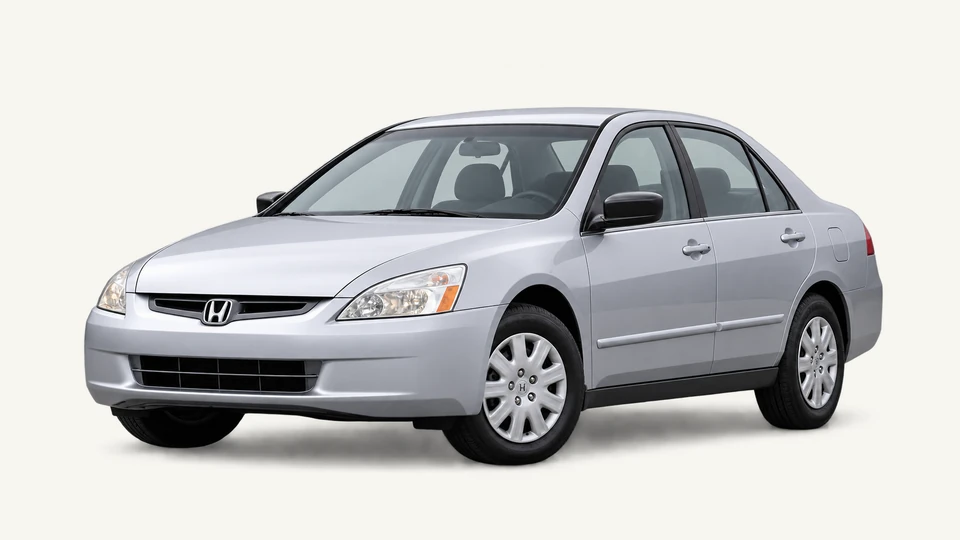
Should You Buy the 2004 Honda Accord?
Only after careful checks. Our reliability score for the 2004 Honda Accord is 65 out of 100, which rates Caution. Owners reported fewer problems than for the average car of the same age. It ranks 21st of the 25 Accord years we score.
The most reported problem is the transmission, mostly failure or loss of drive (301 of 1,016 complaints). Owners also complain about airbag warning lights and the screen and audio. 425 of the 1,016 complaints describe a serious outcome, such as a crash, a fire, an injury or stalling while driving.
It has 13 recalls. For comparison, the 2003 scores 60 and the 2005 scores 71.
Before you buy, check that the recalls were done and get an independent inspection. The full checklist is at the end of this page.
Pros
- Fewer problems than the average car its age
- No do-not-drive or park-outside recalls
Cons
- More complaints than average about major systems in the last two years
- Transmission: failure or loss of drive301 complaints
- Airbag warning light83 complaints
- Screen and audio: stopped working57 complaints
How the 2004 Accord Earned Its Score
Every model year starts at 100. Each part takes points away when this year has more problems than the average car of the same age. How we score
| Item | Vs average | Points lost |
|---|---|---|
| Starting score | 100 | |
| Serious problems | 0.92× | −10 |
| Everyday problems | 0.69× | −4 |
| Problems in the last two years | 1.9× | −12 |
| Recalls | 2.8× | −9 |
| Score | 65 |
What Owners Report
We read all 1,016 complaints filed with NHTSA for the 2004 Honda Accord, one by one, and grouped them by the problem they describe. The most reported problems come first.
Transmission: failure or loss of drive
301 complaints (30%)
Failure or loss of drive, harsh or delayed shifts and slipping. 243 of these 301 complaints describe a serious outcome, most often stalling or losing power while driving. In 4 complaints, the dealer could not find or fix the problem, and in 15 it came back after a repair. Median mileage when it started: about 101,000 miles.
Airbag warning light
83 complaints (8%)
Warning lights, problems that come and go and a failure. Median mileage when it started: about 88,000 miles.
Screen and audio: stopped working
57 complaints (6%)
A feature that stopped working, problems that come and go and the system acting on its own. 4 of these 57 complaints describe a serious outcome. Median mileage when it started: about 98,000 miles.
Steering: a leak
56 complaints (6%)
A leak, pulling or wandering and loss of steering control. 7 of these 56 complaints describe a serious outcome, most often a crash. In 5 complaints, the problem came back after a repair. Median mileage when it started: about 115,000 miles.
Airbags: no deployment in a crash
50 complaints (5%)
No deployment in a crash, deployment with no crash and damage. 12 of these 50 complaints describe a serious outcome, most often an airbag problem. Median mileage when it started: about 100,000 miles.
Brakes: loss of braking
50 complaints (5%)
Loss of braking, early wear and vibration or shudder. 8 of these 50 complaints describe a serious outcome, most often loss of braking. In 7 complaints, the dealer could not find or fix the problem, and in 7 it came back after a repair. Median mileage when it started: about 16,000 miles.
Unintended acceleration (cause not stated)
38 complaints (4%)
Sudden acceleration and surging. 23 of these 38 complaints describe a serious outcome, most often sudden acceleration or braking. In 6 complaints, the dealer could not find or fix the problem. Median mileage when it started: about 45,000 miles.
Seat belts: the system not working when needed
33 complaints (3%)
The system not working when needed, a failure and locking up. 1 of these 33 complaints describes a serious outcome: an injury. Median mileage when it started: about 71,000 miles.
Paint and rust: peeling
24 complaints (2%)
Peeling, damage and rust or corrosion. Median mileage when it started: about 101,000 miles.
Windshield wipers: stopped working
22 complaints (2%)
A feature that stopped working, problems that come and go and parts breaking or coming apart. 13 of these 22 complaints describe a serious outcome, most often loss of visibility. Median mileage when it started: about 73,000 miles.
Frontal airbags: no deployment in a crash
20 complaints (2%)
No deployment in a crash, deployment injury and a failure. 5 of these 20 complaints describe a serious outcome, most often an airbag problem. Median mileage when it started: about 70,000 miles.
Wiring, fuses or body control module failure
19 complaints (2%)
A failure, parts breaking or coming apart and problems that come and go. 3 of these 19 complaints describe a serious outcome, most often stalling or losing power while driving. Median mileage when it started: about 66,000 miles.
Instrument cluster: stopped working
18 complaints (2%)
A feature that stopped working and wrong readings. Median mileage when it started: about 102,000 miles.
Loss of power (cause not stated)
18 complaints (2%)
A loss of power, reduced power or limp mode and failure or loss of drive. 14 of these 18 complaints describe a serious outcome, most often stalling or losing power while driving. Median mileage when it started: about 88,000 miles.
Side or curtain airbags: deployment with no crash
16 complaints (2%)
Deployment with no crash and no deployment in a crash. 3 of these 16 complaints describe a serious outcome, most often an airbag problem. Median mileage when it started: about 64,000 miles.
Show 60 more problems
Car not starting (cause not stated)
13 complaints (1%)
The car not starting. 11 of these 13 complaints describe a serious outcome, most often a car that would not start. In 4 complaints, the dealer could not find or fix the problem. Median mileage when it started: about 3,000 miles.
Tires: damage
12 complaints (1%)
Damage, parts breaking or coming apart and poor traction. 1 of these 12 complaints describes a serious outcome. Median mileage when it started: about 25,000 miles.
Ignition or push-button start: sticking or stiffness
11 complaints (1%)
Sticking or stiffness, stalling and not releasing. 5 of these 11 complaints describe a serious outcome, most often stalling or losing power while driving. Median mileage when it started: about 88,000 miles.
Seats: loose seat track
11 complaints (1%)
Loose seat track, parts breaking or coming apart and the system acting on its own. 1 of these 11 complaints describes a serious outcome. Median mileage when it started: about 50,000 miles.
Stall (cause not stated)
11 complaints (1%)
Stalling. 7 of these 11 complaints describe a serious outcome, most often stalling or losing power while driving. Median mileage when it started: about 134,000 miles.
Headlights: works on and off
10 complaints (under 1%)
Problems that come and go, poor illumination and loose cover. Median mileage when it started: about 65,000 miles.
Noise (cause not stated)
10 complaints (under 1%)
Unusual noises. Median mileage when it started: about 88,000 miles.
Torque converter failure
9 complaints (under 1%)
A failure, a stored fault code and vibration or shudder. 5 of these 9 complaints describe a serious outcome, most often stalling or losing power while driving. Median mileage when it started: about 100,000 miles.
Shifter or park: parts breaking or coming apart
8 complaints (under 1%)
Parts breaking or coming apart, changed position and the system acting on its own. 3 of these 8 complaints describe a serious outcome, most often a crash. Median mileage when it started: about 116,000 miles.
Engine: stalling
7 complaints (under 1%)
Stalling, surging and smoke or a burning smell. 4 of these 7 complaints describe a serious outcome, most often stalling or losing power while driving. Median mileage when it started: about 40,000 miles.
Transmission fluid leak
7 complaints (under 1%)
A leak. 1 of these 7 complaints describes a serious outcome. Median mileage when it started: about 67,000 miles.
Vibration (cause not stated)
7 complaints (under 1%)
Vibration or shudder. 1 of these 7 complaints describes a serious outcome. Median mileage when it started: about 49,000 miles.
12V battery failure
6 complaints (under 1%)
A failure that needed a new part. 1 of these 6 complaints describes a serious outcome: a car that would not start. Median mileage when it started: about 118,000 miles.
A/C: stopped working
6 complaints (under 1%)
A feature that stopped working, a failure that needed a new part and water leaking in. Median mileage when it started: about 45,000 miles.
CV axles: parts breaking or coming apart
6 complaints (under 1%)
Parts breaking or coming apart, a failure that needed a new part and vibration or shudder. 1 of these 6 complaints describes a serious outcome: loss of steering control. Median mileage when it started: about 106,000 miles.
Radio or HVAC control illumination: stopped working
6 complaints (under 1%)
A feature that stopped working. 1 of these 6 complaints describes a serious outcome. Median mileage when it started: about 40,000 miles.
Power windows or regulator: stopped working
6 complaints (under 1%)
A feature that stopped working, a failure that needed a new part and parts breaking or coming apart. Median mileage when it started: about 97,000 miles.
ABS failure
5 complaints (under 1%)
A failure, the system acting on its own and the system not working when needed. 3 of these 5 complaints describe a serious outcome, most often loss of braking. Median mileage when it started: about 55,000 miles.
Brake calipers: locking up
5 complaints (under 1%)
Locking up, sticking or stiffness and vibration or shudder. 2 of these 5 complaints describe a serious outcome. Median mileage when it started: about 84,000 miles.
Engine mounts: parts breaking or coming apart
5 complaints (under 1%)
Parts breaking or coming apart, a failure and vibration or shudder. Median mileage when it started: about 91,000 miles.
Passenger airbag sensor: warning lights
5 complaints (under 1%)
Warning lights, the system acting on its own and the system not working when needed. Median mileage when it started: about 88,000 miles.
Fire (cause not stated)
5 complaints (under 1%)
A fire. 4 of these 5 complaints describe a serious outcome, most often a fire. Median mileage when it started: about 18,000 miles.
Uneven tire wear: pulling or wandering
4 complaints (under 1%)
Pulling or wandering and early wear.
Climate controls: stopped working
4 complaints (under 1%)
A feature that stopped working. Median mileage when it started: about 124,000 miles.
Cooling system: a leak
4 complaints (under 1%)
A leak and contaminated coolant.
Engine sensors or computer failure
4 complaints (under 1%)
A failure that needed a new part, damage and rust or corrosion. 2 of these 4 complaints describe a serious outcome, most often a car that would not start. Median mileage when it started: about 81,000 miles.
Key fob: stopped working
4 complaints (under 1%)
A feature that stopped working, parts breaking or coming apart and a failure. 1 of these 4 complaints describes a serious outcome. Median mileage when it started: about 77,000 miles.
Accelerator pedal: sticking or stiffness
4 complaints (under 1%)
Sticking or stiffness. All 4 describe a serious outcome, most often sudden acceleration or braking. Median mileage when it started: about 95,000 miles.
Ball joints and control arms: parts breaking or coming apart
3 complaints (under 1%)
Parts breaking or coming apart. 1 of these 3 complaints describes a serious outcome.
Body seals (water leak): water leaking in
3 complaints (under 1%)
Water leaking in.
Check engine light (cause not stated)
3 complaints (under 1%)
Warning lights. Median mileage when it started: about 4,000 miles.
Exterior lights: stopped working
3 complaints (under 1%)
A feature that stopped working, a failure and shattering or cracking.
Manual transmission or clutch failure
3 complaints (under 1%)
A failure, slipping and harsh or delayed shifts. Median mileage when it started: about 10,000 miles.
Mirrors: parts breaking or coming apart
3 complaints (under 1%)
Parts breaking or coming apart, optical distortion and shattering or cracking.
Seat position sensor failure
3 complaints (under 1%)
A failure and a stored fault code. Median mileage when it started: about 85,000 miles.
Parking brake: the car rolling away
3 complaints (under 1%)
The car rolling away, locking up and warning lights. 1 of these 3 complaints describes a serious outcome: a crash.
Poor acceleration (cause not stated)
3 complaints (under 1%)
Hesitation and reduced power or limp mode. 1 of these 3 complaints describes a serious outcome: stalling or losing power while driving. Median mileage when it started: about 120,000 miles.
Door lock actuators: stopped working
3 complaints (under 1%)
A feature that stopped working.
A/C compressor: locking up
2 complaints (under 1%)
Locking up.
A/C condenser: damage
2 complaints (under 1%)
Damage.
Alternator or charging: warning lights
2 complaints (under 1%)
Warning lights.
Defroster: stopped working
2 complaints (under 1%)
A feature that stopped working. 1 of these 2 complaints describes a serious outcome: a crash.
Engine (misfire codes): rough running or misfires
2 complaints (under 1%)
Rough running or misfires. 1 of these 2 complaints describes a serious outcome: stalling or losing power while driving.
Exhaust or catalytic converter: vibration or shudder
2 complaints (under 1%)
Vibration or shudder and a bad smell.
Fuel economy: high fuel use
2 complaints (under 1%)
High fuel use.
Horn: stopped working
2 complaints (under 1%)
A feature that stopped working.
Ignition coils or spark plugs: parts breaking or coming apart
2 complaints (under 1%)
Parts breaking or coming apart and a failure that needed a new part.
Interior trim: parts breaking or coming apart
2 complaints (under 1%)
Parts breaking or coming apart and unusual noises.
Cabin water leak (cause not stated)
2 complaints (under 1%)
Water leaking in.
Clock spring failure
2 complaints (under 1%)
A failure.
Cruise control: stopped working
2 complaints (under 1%)
A feature that stopped working.
Engine bay insulation: a fire
2 complaints (under 1%)
A fire. Both describe a serious outcome, most often a fire.
Hood struts failure
2 complaints (under 1%)
A failure that needed a new part.
Interior lighting: stopped working
2 complaints (under 1%)
A feature that stopped working.
Rear window glass: shattering or cracking
2 complaints (under 1%)
Shattering or cracking.
Suspension: parts breaking or coming apart
2 complaints (under 1%)
Parts breaking or coming apart. 1 of these 2 complaints describes a serious outcome.
Starter failure
2 complaints (under 1%)
A failure and the car not starting. Both describe a serious outcome, most often a car that would not start.
Struts or shocks failure
2 complaints (under 1%)
A failure that needed a new part.
Taillights or brake lights: parts breaking or coming apart
2 complaints (under 1%)
Parts breaking or coming apart and problems that come and go.
Windshield: optical distortion
2 complaints (under 1%)
Optical distortion.
Reported Once (67)
Show the 67 problems reported once
- Cabin odor or mold: a bad smell
- Control arm bushings: parts breaking or coming apart
- Cylinder head gasket failure
- Door latches: parts breaking or coming apart
- Engine air intake: parts breaking or coming apart
- Engine oil consumption: burning or using oil
- Exterior trim: parts breaking or coming apart
- Frame or structure: damage
- Fuel pump: shattering or cracking
- Fuel system: fault code
- Fuel leak
- Fumes in cabin (cause not stated)
- Heater: not shutting off
- A/C drain hose: water leaking in
- ABS electrical switch failure
- Aftermarket iPod adapter: draining the battery
- Airbag sensor failure
- Brake O-ring failure
- Center console lights: stopped working
- Cruise control cable: sticking or stiffness
- Cruise control cable or bracket: parts breaking or coming apart
- Cylinder head threads: damage
- Dashboard control backlights: stopped working
- Dome light failure
- Driver airbag sensor failure
- Driver seat airbag sensor failure
- Driver seat position sensor failure
- Electrical load detector failure
- Emissions controller: a leak
- Fender: damage
- Front door (will not stay open): stopped working
- Front end feels unstable (cause not stated)
- Front suspension: pulling or wandering
- Gear shift illumination: stopped working
- Hood support struts failure
- Idler tensioner pulleys failure
- Interior control lighting: stopped working
- Interior illumination: stopped working
- Interior lights: stopped working
- Oil pan: damage
- Passenger airbag sensor: stopped working
- Roof: damage
- Seat sensor failure
- Serpentine belt: shattering or cracking
- Throttle: sudden acceleration
- Throttle body: sticking or stiffness
- Throttle box: sudden acceleration
- Tire valve stem: parts breaking or coming apart
- Transfer case: unusual noises
- Transmission bushings: early wear
- Transmission carrier bearing: a leak
- Trunk latch: not closing or latching
- Trunk release switch: stopped working
- Vehicle electrical power: stopped working
- Vehicle smoking (cause not stated)
- Wheel lug nuts: loose mounting
- Wheel nut: damage
- Window seals or guides: damage
- Window wind noise: unusual noises
- Windshield washer: stopped working
- Stability control (VSA): stopped working
- Sunroof: parts breaking or coming apart
- Valve train: unusual noises
- Warning lights (cause not stated)
- Wheel rim: damage
- Wheels seized (cause not stated)
- Windows or locks or sunroof (operate by themselves): the system acting on its own
How the 2004 Honda Accord Compares With Other Years
The other Accord years of the 7th generation, 2003 to 2007, and the years just before and after it. When two scores are less than 3.5 points apart, treat them as about the same.
| Year | Rating | Score | Vs average | Per 10k cars | Recalls | Most reported problem |
|---|---|---|---|---|---|---|
| 2008 | Good | 73 | 0.75× | 34.2 | 8 | Brakes: early wear |
| 2007 | Good | 76 | 0.36× | 11.6 | 9 | Steering: a leak |
| 2006 | Good | 75 | 0.37× | 12.0 | 12 | Steering: a leak |
| 2005 | Good | 71 | 0.57× | 17.1 | 15 | Airbag warning light |
| 2004 This year | Caution | 65 | 0.85× | 24.3 | 13 | Transmission: failure or loss of drive |
| 2003 | Caution | 60 | 1.6× | 44.4 | 13 | Transmission: failure or loss of drive |
| 2002 | Good | 72 | 0.80× | 23.3 | 5 | Transmission: slipping |
2004 Honda Accord Recalls
A recall can cover some or all cars of this model year. Look up a specific car by its VIN at NHTSA to see which recalls are still open on it.
Air bags: inflator module
An inflator explosion may result in sharp metal fragments striking the driver or other occupants resulting in serious injury or death.
NHTSA 19V499000Recall report (PDF)Owner letter (PDF)Issued Jun 27, 2019. By the fourth quarter of 2020, 22% of the cars in this recall had been fixed.
Air bags: inflator module
An inflator explosion may result in sharp metal fragments striking the driver or other occupants resulting in serious injury or death.
NHTSA 19V501000Recall report (PDF)Owner letter (PDF)Issued Jun 27, 2019. By the fourth quarter of 2020, 42% of the cars in this recall had been fixed.
Air bags: inflator module
An explosion of an inflator within the driver frontal air bag module may result in sharp metal fragments striking the driver, front seat passenger or other occupants resulting in serious injury or death.
NHTSA 19V182000Recall report (PDF)Owner letter (PDF)Issued Mar 6, 2019. By the third quarter of 2020, 49% of the cars in this recall had been fixed.
Air bags: inflator module
An incorrectly installed air bag may deploy improperly in the event of a crash, increasing the risk of injury.
NHTSA 18V268000Recall report (PDF)Owner letter (PDF)Issued Apr 26, 2018. By the third quarter of 2019, 85% of the cars in this recall had been fixed.
Air bags: inflator module
An air bag module does not meet the advanced air bag requirements can increase the risk of injury or death in the event of a crash.
NHTSA 16V178000Recall report (PDF)Owner letter (PDF)Issued Mar 30, 2016. By the third quarter of 2017, 27% of the cars in this recall had been fixed.
Air bags: inflator module
In the event of a crash necessitating deployment of the passenger's frontal air bag, the inflator could rupture with metal fragments striking the passenger seat occupant or other occupants possibly causing serious injury or death.
NHTSA 15V370000Recall report (PDF)Owner letter (PDF)Issued Jun 15, 2015. By the fourth quarter of 2017, 65% of the cars in this recall had been fixed.
Show 7 more recalls
Air bags: inflator module
In the event of a crash necessitating deployment of the driver's frontal air bag, the inflator could rupture with metal fragments striking the driver or other occupants resulting in serious injury or death.
NHTSA 15V320000Recall report (PDF)Owner letter (PDF)Issued May 28, 2015. By the fourth quarter of 2017, 68% of the cars in this recall had been fixed.
Air bags
In the event of a crash necessitating deployment of the passengers frontal air bag, the inflator could rupture with metal fragments striking the vehicle occupants potentially resulting in serious injury or death.
NHTSA 14V700000Recall report (PDF)Owner letter (PDF)Issued Nov 4, 2014. By the first quarter of 2016, 70% of the cars in this recall had been fixed.
Air bags
In the event of a crash necessitating deployment of the passengers frontal air bag, the inflator could rupture with metal fragments striking the vehicle occupants potentially resulting in serious injury or death.
NHTSA 14V353000Recall report (PDF)Owner letter (PDF)Issued Jun 20, 2014. By the fourth quarter of 2015, 70% of the cars in this recall had been fixed.
Steering: hose, piping, and connections
If this occurs, power steering fluid can leak onto a hot catalytic converter, leading to smoke and possibly an under-hood fire.
NHTSA 12V222000Owner letter (PDF)Issued May 17, 2012.
Air bags: sensor/control module-inactive
A failure of the sps causes the air bag system to default to full inflation pressure, regardless of the seat position. Full deployment of the driver's air bag can increase the risk of injury for smaller drivers in a frontal crash.
NHTSA 07V001000Owner letter (PDF)Issued Jan 3, 2007.
Air bags: frontal
A torn air bag may not offer the same level of protection, in the event of a crash, thereby increasing the risk of injury to the driver.
NHTSA 04V551000Owner letter (PDF)Issued Nov 18, 2004.
Power train: automatic transmission
Gear failure could result in transmission lockup, which could result in a crash.
NHTSA 04V176000Owner letter (PDF)Issued Apr 15, 2004.
Honda Warranty Extensions and Programs
Repairs Honda agreed to cover or update outside a recall. Whether one applies depends on the VIN and the conditions listed. A Honda dealer can confirm.
- Customer support programHonda 20-010
Driver's airbag inflator
- The problem:
- The driver's airbag inflator can be faulty, and the airbag warning light comes on.
- The fix:
- A Honda dealer replaces the driver's airbag inflator for free.
- Who qualifies:
- The airbag warning light must be on. A Honda dealer test must show the inflator is faulty. Only replacement inflators that fail later are covered. Open inflator recalls must be done first. Salvage or branded titles are not covered.
- Coverage:
- Covered until January 31, 2030.
- Customer support programHonda 20-015
Front passenger's airbag inflator
- The problem:
- The front passenger's airbag inflator can be faulty, and the airbag warning light comes on.
- The fix:
- A Honda dealer replaces the front passenger's airbag inflator for free.
- Who qualifies:
- The airbag warning light must be on. A Honda dealer test must show the inflator is faulty. Only replacement inflators that fail later are covered. Open inflator recalls must be done first. Salvage or branded titles are not covered.
- Coverage:
- Covered until January 31, 2030.
- Customer support programHonda 18-047Ended
Driver's airbag inflator
- The problem:
- The driver's airbag inflator can be faulty, and the airbag warning light comes on.
- The fix:
- While the program ran, a Honda dealer replaced the driver's airbag inflator for free.
- Who qualifies:
- The airbag warning light had to be on. A Honda dealer test had to show the inflator was faulty. Only replacement inflators that failed later were covered. Salvage or branded titles were not covered.
- Coverage:
- The program ended on June 30, 2022.
- Customer support programHonda 18-065Ended
Front passenger's airbag inflator
- The problem:
- The front passenger's airbag inflator can be faulty, and the airbag warning light comes on.
- The fix:
- While the program ran, a Honda dealer replaced the front passenger's airbag inflator for free.
- Who qualifies:
- The airbag warning light had to be on. A Honda dealer test had to show the inflator was faulty. Only replacement inflators that failed later were covered. Salvage or branded titles were not covered.
- Coverage:
- The program ended on October 31, 2022.
NHTSA Investigations
Defect investigations by NHTSA that cover this model year, with what they found.
Driver air bag fabric tearing in crash tests
Led to a recallNHTSA's preliminary evaluation of 2004 Accords began after government crash tests. In two of 13 tests, the driver air bag tore and failed to deploy properly. Honda found the fabric could snag on the module cover. Honda recalled 228,932 2004 and 28,428 early 2005 four-cylinder Accord sedans under recall 04V-551. NHTSA closed the case in November 2004.
NHTSA PE04053Opening report (PDF)Closing report (PDF)Jul 26, 2004 to Nov 22, 2004
Takata air bag inflators rupturing, mostly in humid areas
Led to a recallNHTSA's preliminary evaluation began in June 2014 after six Takata air bag inflator ruptures. It covered Honda Accord, Civic, CR-V, Odyssey and Pilot models from 2001 to 2007, among others. All 10 makers started regional recalls within about two weeks. NHTSA asked them to widen the recalls. It closed in March 2015 and moved to engineering analysis EA15-001.
NHTSA PE14016Opening report (PDF)Closing report (PDF)Jun 11, 2014 to Mar 2, 2015
Takata air bag inflator ruptures across all makers
Still openNHTSA's engineering analysis, opened in February 2015, covers Takata air bag inflators that can rupture. It includes Honda Accord, Civic, CR-V, Odyssey and Pilot models from 2001 to 2007, among others. NHTSA is studying the root cause, the affected vehicles and whether repairs are adequate. The record links 194 recall campaigns to it. It is still open.
NHTSA EA15001Opening report (PDF)Open since Feb 24, 2015
Rupture risk in Takata inflators with a desiccant
Still openNHTSA's engineering analysis, opened in September 2021, asks whether Takata inflators with a moisture-trapping desiccant could degrade and rupture over time. They are not yet recalled. It covers Honda Accord, Civic, CR-V, Odyssey and Pilot models from 2001 to 2015, among others. No field ruptures have been reported in them. The case is still open.
NHTSA EA21002Opening report (PDF)Open since Sep 17, 2021
NHTSA Crash Test Ratings
NHTSA gave the 2004 Accord no overall, frontal or side rating. It did rate each seat in those tests and lists the seat ratings under Rating Breakdown on its page. We show them the same way below. These tests are from before 2011, so the stars are not comparable with ratings for 2011 and newer models. See the 2004 Accord ratings on NHTSA.gov.
4-door
2-door
Check Before You Buy
A checklist for the 2004 Accord, from its recalls, Honda's programs and the problems owners report most.
Confirm the Recalls Were Done
Ask the seller for proof that each of these recalls was repaired.
- Air bags: inflator module NHTSA 19V499000
- Air bags: inflator module NHTSA 19V501000
- Air bags: inflator module NHTSA 19V182000
- Air bags: inflator module NHTSA 18V268000
- Air bags: inflator module NHTSA 16V178000
- Look up the VIN at NHTSA to see all 13 recalls and which are still open.
On the Test Drive
- Accelerate gently from a stop and again at 20 to 40 mph. Shudder, slipping or harsh shifts are warning signs. Ask for the transmission fluid records.
- Test the screen, audio and phone connection for freezing or rebooting.
- Turn the wheel fully left and right, parked and at low speed. Sticking, notches or stiffness are warning signs.
Ask the Seller
Ask whether any of these were ever repaired, and ask to see the receipts.
- Transmission
- Airbag warning lights
- Screen and audio
- Also ask for the service records, especially oil changes and transmission fluid changes.
Before You Pay
- Get an independent pre-purchase inspection from a mechanic you choose.
- Decode the VIN to confirm the model year, engine and trim.
- Check the title for salvage, flood or rebuilt branding.
What to do next