2013 Audi A7 Reliability Report
NHTSA data as of Oct 15, 2026Published Oct 19, 2026
Ranks 7th of 8 A7 years we score.
- Owner complaints
- 35
- 2 are recall notices
- Per 10,000 cars
- 42.7
- 7,722 made for the U.S.
- Vs the average car
- 1.4×
- same age, 1× is average
- Serious outcomes
- 18
- crash, fire, injury, stall or tow
- Recalls
- 7
- NHTSA crash rating
- –
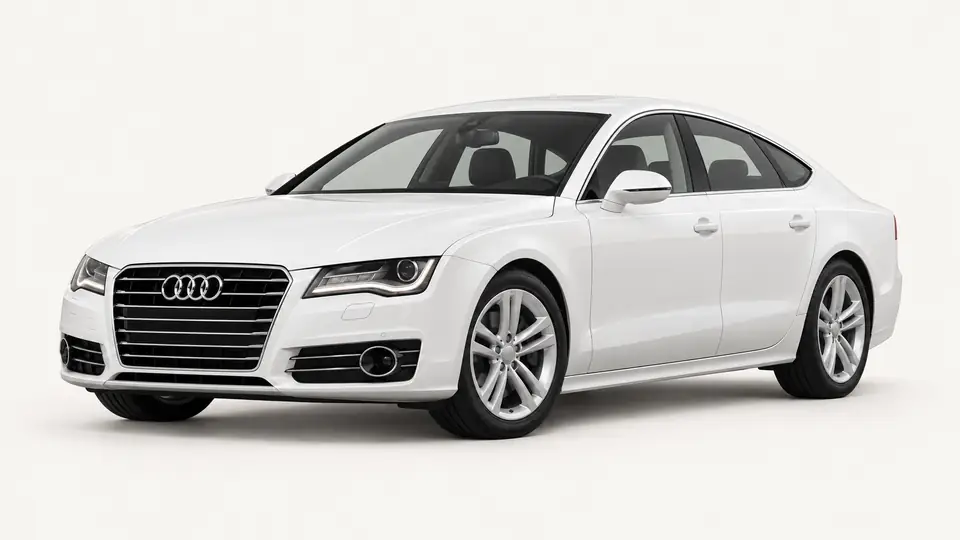
Should You Buy the 2013 Audi A7?
Only after careful checks. Our reliability score for the 2013 Audi A7 is 66 out of 100, which rates Caution. Owners reported about 1.4 times as many problems as for the average car of the same age. It ranks 7th of the 8 A7 years we score.
The most reported problem is the turbocharger, mostly stalling (13 of 35 complaints). Owners also complain about the turbo oil strainer and the steering. 18 of the 35 complaints describe a serious outcome, such as a crash, a fire, an injury or stalling while driving.
It has 7 recalls. Audi also offers four warranty extensions that may still apply, for problems with the engine and driver assistance systems. For comparison, the 2012 scores 73 and the 2014 scores 69.
Before you buy, check that the recalls were done, ask an Audi dealer about warranty extension AWA-13-07 and get an independent inspection. The full checklist is at the end of this page.
Pros
- No do-not-drive or park-outside recalls
- 4 Audi warranty extensions may cover repairs
Cons
- About 1.4 times the problems of the average car its age
- Turbocharger: stalling13 complaints
- Turbo oil strainer failure4 complaints
- Steering: sticking or stiffness4 complaints
How the 2013 A7 Earned Its Score
Every model year starts at 100. Each part takes points away when this year has more problems than the average car of the same age. How we score
| Item | Vs average | Points lost |
|---|---|---|
| Starting score | 100 | |
| Serious problems | 1.6× | −21 |
| Everyday problems | 0.96× | −7 |
| Problems in the last two years | Not counted | – |
| Recalls | 1.2× | −6 |
| Score | 66 |
Problems in the last two years are not counted for the 2013 A7. If it were exactly average, its 7,722 cars would draw about 2.1 complaints in two years at this age, too few to compare. Their 30% moves to serious and everyday problems, which count for 80% of this score instead of 50%.
What Owners Report
We read all 35 complaints filed with NHTSA for the 2013 Audi A7, one by one, and grouped them by the problem they describe. The most reported problems come first. A complaint that describes more than one problem is counted under each, so the counts add up to more than 35.
Turbocharger: stalling
13 complaints (37%)
Stalling, failure or loss of drive and a loss of power. 6 of these 13 complaints describe a serious outcome, most often stalling or losing power while driving. Median mileage when it started: about 72,000 miles.
Turbo oil strainer failure
4 complaints (11%)
A failure. Median mileage when it started: about 46,000 miles.
Steering: sticking or stiffness
4 complaints (11%)
Sticking or stiffness, problems that come and go and locking up. 2 of these 4 complaints describe a serious outcome, most often loss of steering control. Median mileage when it started: about 56,000 miles.
Engine failure
2 complaints (6%)
A failure that needed a new part and damage.
Unintended acceleration (cause not stated)
2 complaints (6%)
Surging and sudden acceleration. 1 of these 2 complaints describes a serious outcome: a crash.
Reported Once (18)
Show the 18 problems reported once
- PCV valve or crankcase breather failure
- Airbag warning light
- Automatic emergency braking: hard braking with nothing ahead
- Engine oil leak
- Exhaust or catalytic converter: hesitation
- Fuel pump: a leak
- Passenger airbag sensor
- HomeLink: stopped working
- Suspension control module: works on and off
- Vehicle alarm: the system acting on its own
- Phone and navigation: stopped working
- Seat belts: stopped working
- Start-stop system: stalling
- Tires: parts breaking or coming apart
- Transmission: a leak
- Wheel rim: damage
- Windshield: shattering or cracking
- Wiring, fuses or body control module: damage
How the 2013 Audi A7 Compares With Other Years
The other A7 years of the 1st generation, 2012 to 2018, and the years just before and after it.
| Year | Rating | Score | Vs average | Per 10k cars | Recalls | Most reported problem |
|---|---|---|---|---|---|---|
| 2019 | Avoid | 57 | 3.1× | 74.9 | 6 | Alternator or charging: failure or loss of drive |
| 2018 | Excellent | 81 | 0.42× | 7.0 | 3 | – |
| 2017 | Good | 76 | 0.57× | 11.4 | 6 | Turbocharger: stalling |
| 2016 | Good | 72 | 0.96× | 27.1 | 5 | Turbocharger: stalling |
| 2015 | Good | 73 | 0.78× | 19.2 | 5 | Turbocharger: stalling |
| 2014 | Caution | 69 | 1.1× | 32.0 | 5 | Turbocharger: parts breaking or coming apart |
| 2013 This year | Caution | 66 | 1.4× | 42.7 | 7 | Turbocharger: stalling |
| 2012 | Good | 73 | 0.75× | 23.8 | 5 | Cooling system: a leak |
2013 Audi A7 Recalls
Seven recalls cover the 2013 Audi A7. The most recent was issued in March 2022: “Blocked Turbocharger Oil Strainer.” A VIN check at NHTSA shows which are still open on a given car.
Blocked Turbocharger Oil Strainer
Worn bearings can cause the turbine wheel to contact the turbocharger housing or cause the shaft to break, causing an engine stall and increasing the risk of a crash.
NHTSA 22V178000Recall report (PDF)Owner letter (PDF)Issued Mar 23, 2022. By the second quarter of 2024, 79% of the cars in this recall had been fixed.
Passenger's Air Bag May Deploy Improperly
If the PODS module malfunctions, the front passenger air bag may not deploy properly in the event of a crash, increasing the risk of injury.
NHTSA 18V370000Recall report (PDF)Owner letter (PDF)Issued Jun 4, 2018. By the first quarter of 2020, 85% of the cars in this recall had been fixed.
Fuel Line May Leak Fuel
A fuel leak in the presence of an ignition source, increases the risk of a fire.
NHTSA 17V781000Recall report (PDF)Owner letter (PDF)Issued Dec 6, 2017. By the second quarter of 2019, 84% of the cars in this recall had been fixed.
Engine Compartment Fuel Hose May Degrade and Leak
A fuel leak in the presence of an ignition source increases the risk of a fire.
NHTSA 16V646000Recall report (PDF)Owner letter (PDF)Issued Sep 7, 2016. By the first quarter of 2018, 87% of the cars in this recall had been fixed.
Passenger Seat Occupant Detection System May Fail
In vehicles with heated and cooled seats, the Passenger Occupant Detection System (PODS), used to enable the front passenger air bags, may malfunction and prevent the passenger-side air bags from deploying in a crash. An air bag that does not deploy as intended increases the risk of occupant injury in a crash.
NHTSA 15V823000Owner letter (PDF)Issued Dec 8, 2015. By the second quarter of 2017, 92% of the cars in this recall had been fixed.
Fuel Injection System Fuel Leak
A fuel leak in the injection system in the presence of an ignition source, increases the risk of a fire.
NHTSA 15V019000Recall report (PDF)Owner letter (PDF)Issued Jan 20, 2015. By the second quarter of 2016, 92% of the cars in this recall had been fixed.
Show 1 more recalls
Fuel Line Leak
A fuel leak, in the presence of an ignition source, may result in a fire.
NHTSA 13V450000Issued Sep 23, 2013. By the first quarter of 2015, 98% of the cars in this recall had been fixed.
2013 Audi A7 Warranty Extensions and Programs
Audi has four warranty extensions for the 2013 Audi A7, separate from its recalls. They are for problems with the engine and driver assistance systems. Whether one applies to a car depends on its VIN, which an Audi dealer can check.
- Warranty extensionAudi AWA-13-07
Carbon buildup in engine secondary air ports
- The problem:
- Carbon can build up in the engine's secondary air ports. Fault codes then turn on the check engine light, and the car can fail an emissions test.
- The fix:
- An Audi dealer diagnoses the problem and, if needed, cleans the carbon out of the secondary air ports for free.
- Who qualifies:
- Certain 2009 to 2012 Audis with the 3.2 engine and 2009 to 2013 Audis with the 3.0T engine. Other causes of the warning light and damage from tuned engine computers are not covered.
- Coverage:
- 10 years or 120,000 miles from the original in-service date, whichever comes first.
- Warranty extensionAudi AWA-19-03
Crankcase ventilation valve whistle and warning light
- The problem:
- The crankcase ventilation valve can fail. It causes a whistling noise in the engine bay and turns on the check engine light.
- The fix:
- An Audi dealer replaces the crankcase ventilation valve for free if it diagnoses the valve as faulty.
- Who qualifies:
- Certain 2013 to 2016 Audis with a 3.0 or 4.0 gasoline engine. Cars with a branded title, such as salvage, flood, rebuilt, fleet or lemon law buyback, or bought from a junkyard or body shop, are excluded.
- Coverage:
- 10 years or 120,000 miles from the in-service date, whichever comes first.
- Warranty extensionAudi AWA-22-02
4.0 engine turbo failure
- The problem:
- The turbo on the 4.0 engine can be faulty. The bulletin does not describe the symptoms.
- The fix:
- An Audi dealer repairs or replaces a faulty turbo, with any parts and labor needed.
- Who qualifies:
- Certain 2013 to 2017 Audis with the 4.0 turbo engine. The bulletin names no model. Cars already repaired still qualify, but totaled cars do not.
- Coverage:
- 10 years or 120,000 miles from the original in-service date, whichever comes first.
- Warranty extensionAudi AWA-24-04
Automatic emergency braking system faults
- The problem:
- The automatic emergency braking, or AEB, system can malfunction when its control unit, a camera, the LIDAR or a sensor fails.
- The fix:
- An Audi dealer repairs the AEB fault and Audi pays 75 percent of the cost. Damage from crashes, impacts, moved sensors or weather is not covered.
- Who qualifies:
- Certain Audis covered by the settlement, with a confirmed fault in the AEB control unit, cameras, LIDAR or sensors. If the new car warranty's time ran out by May 16, 2024, the extension's time limit was November 16, 2024.
- Coverage:
- Up to 12 months or 12,000 miles after the new car warranty ends. Ask an Audi dealer for the exact terms.
2013 Audi A7 NHTSA Investigations
NHTSA has opened two investigations that cover the 2013 Audi A7. One led to a recall and one other has closed.
Engine stalling after turbocharger failure
ClosedNHTSA's preliminary evaluation looked into sudden engine stalls in 2013-2016 Audi A8, S6, S7, S8 and RS7 cars with 4.0L twin-turbo engines. Owners said turbochargers failed when a clogged oil strainer cut off oil. The strainer is hard to reach for service. NHTSA and Audi had about 824 reports of these stalls. NHTSA upgraded it to an engineering analysis.
NHTSA PE21009Opening report (PDF)Closing report (PDF)Mar 29, 2021 to May 27, 2022
Turbocharger failures from a clogged oil strainer
Led to a recallNHTSA's engineering analysis looked into engine stalls in 2013-2016 Audi A8, S6, S7, S8 and RS7 cars with 4.0L twin-turbo engines. Audi filed recall 22V-178 to replace the oil strainer with a larger mesh one. Cars built since 2017 with that strainer had no reported turbo failures from oil starvation. NHTSA closed the analysis, citing the recall.
NHTSA EA22001Opening report (PDF)Closing report (PDF)Apr 4, 2022 to May 26, 2023
Check Before You Buy
A checklist for the 2013 A7, from its seven recalls, four Audi warranty extensions that may still apply and the problems owners report most.
Confirm the Recalls Were Done
Ask the seller for proof that each of these recalls was repaired.
- Blocked Turbocharger Oil Strainer NHTSA 22V178000
- Passenger's Air Bag May Deploy Improperly NHTSA 18V370000
- Fuel Line May Leak Fuel NHTSA 17V781000
- Engine Compartment Fuel Hose May Degrade and Leak NHTSA 16V646000
- Passenger Seat Occupant Detection System May Fail NHTSA 15V823000
- Look up the VIN at NHTSA to see all 7 recalls and which are still open.
Ask an Audi Dealer
Ask whether each of these warranty extensions applies to this VIN, and whether the work was done.
- AWA-13-07: carbon buildup in engine secondary air ports
- AWA-19-03: crankcase ventilation valve whistle and warning light
- AWA-22-02: 4.0 engine turbo failure
- AWA-24-04: automatic emergency braking system faults
On the Test Drive
- Listen for whistling and watch for reduced-power warnings.
- Turn the wheel fully left and right, parked and at low speed. Sticking, notches or stiffness are warning signs.
Ask the Seller
Ask whether any of these were ever repaired, and ask to see the receipts.
- Turbocharger
- Turbo oil strainer
- Steering
- Also ask for the service records, especially oil changes.
Before You Pay
- Get an independent pre-purchase inspection from a mechanic you choose.
- Decode the VIN to confirm the model year, engine and trim.
- Check the title for salvage, flood or rebuilt branding.
What to do next