
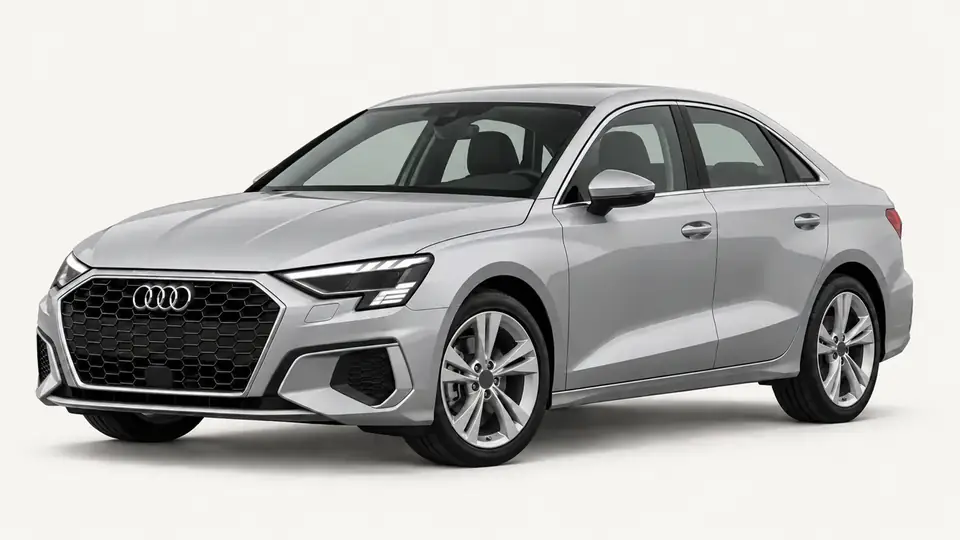
2023 A3
4th generation (8Y)
Good
Most reported problems
- Alternator or charging failure29%
- Sunroof glass (shattered): shattering or cracking29%
- Per 10k cars
- 4.5
- Complaints
- 7
- Recalls
- 2
NHTSA data as of Oct 15, 2026Published Oct 19, 2026
According to our reliability score system, the best Audi A3 years to buy are the 2019, 2020 and 2023. The 2019, 2020 and 2023 score highest, at 78 out of 100.
The 2010 rates Avoid, and the 2009 and 2011 need a careful look. Owners of the 2009 most often report the dual-clutch transmission, mostly harsh or delayed shifts. On the 2010, the main complaint is the fuel pump, mostly parts breaking or coming apart.
Shopping for a newer A3? Among the 2015 and later years, the 2016 to 2020, 2022 and 2023 rate Good. The 2015 is the weak spot. The 2024 has too little data to score. The 2025 and 2026 are too new for a final score.
On a tighter budget, an older A3 from before 2015 can be a smart buy. The 2007, 2012 and 2013 rate Good. Skip or check closely the 2006 and 2008 to 2011.
No A3 year is rated Excellent.
Not rated yet: 2025, 2026, too new for a final score. Not enough data to score: 2024.
No A3 year reaches 80, our Excellent line. These three score highest, all rated Good, led by the 2019, 2020 and 2023 at 78.
4th generation (8Y)
Most reported problems

3rd generation (8V)
Most reported problems
3rd generation (8V)
Most reported problems
Also rated Excellent or Good: 2007, 2012–2013, 2016–2018, 2022.
The 2010 is the only A3 year rated Avoid, with a score of 57. The others are the lowest-scoring years rated Caution.

2nd generation (8P)
Most reported problems
Audi extended the warranty on some 2009 A3s for problems with the engine, brakes and airbags.
Full 2009 report →2nd generation (8P)
Most reported problems
Audi extended the warranty on some 2010 A3s for problems with the engine, fuel system and airbags.
Full 2010 report →2nd generation (8P)
Most reported problems
Audi extended the warranty on some 2011 A3s for problems with the engine, fuel system and airbags.
Full 2011 report →3rd generation (8V)
Most reported problems
Audi extended the warranty on some 2015 A3s for problems with the engine, transmission and driver assistance systems.
Full 2015 report →Also rated Caution or Avoid: 2006, 2008.
A final score needs 36 months of complaints. Until then we show what we know, and a provisional reading once there is enough data.
6 complaints and 0 recalls so far.
Same generation as the 2023, which scored 78 (Good).
What we know so far →3 complaints and 0 recalls so far. First provisional score expected around July 2027.
Same generation as the 2023, which scored 78 (Good).
What we know so far →All model years, newest first. Tap a year for its full report, with the problems owners report, recalls, Audi programs and crash ratings.
| Year | Generation | Rating | Score | Vs average | Complaints | Per 10k cars | Recalls | |
|---|---|---|---|---|---|---|---|---|
| 2026 | 4th generation (8Y) | Too new | – | – | 3 | 5.2 | 0 | Report |
| 2025 | 4th generation (8Y) | Not enough data | – | – | 6 | 7.7 | 0 | Report |
| 2024 | 4th generation (8Y) | Not enough data | – | – | 4 | 3.4 | 0 | Report |
| 2023 | 4th generation (8Y) | Good | 78 | 0.62× | 7 | 4.5 | 2 | Report |
| 2022 | 4th generation (8Y) | Good | 70 | 0.86× | 11 | 10.3 | 7 | Report |
| 2020 | 3rd generation (8V) | Good | 78 | 0.51× | 18 | 10.6 | 3 | Report |
| 2019 | 3rd generation (8V) | Good | 78 | 0.46× | 21 | 13.1 | 4 | Report |
| 2018 | 3rd generation (8V) | Good | 73 | 0.74× | 63 | 22.4 | 7 | Report |
| 2017 | 3rd generation (8V) | Good | 71 | 1.1× | 81 | 34.6 | 5 | Report |
| 2016 | 3rd generation (8V) | Good | 72 | 0.86× | 135 | 30.2 | 6 | Report |
| 2015 | 3rd generation (8V) | Caution | 69 | 0.94× | 233 | 40.9 | 7 | Report |
| 2013 | 2nd generation (8P) | Good | 71 | 0.99× | 20 | 29.4 | 3 | Report |
| 2012 | 2nd generation (8P) | Good | 76 | 0.60× | 43 | 18.0 | 4 | Report |
| 2011 | 2nd generation (8P) | Caution | 68 | 1.2× | 43 | 42.1 | 4 | Report |
| 2010 | 2nd generation (8P) | Avoid | 57 | 3.1× | 50 | 84.2 | 5 | Report |
| 2009 | 2nd generation (8P) | Caution | 60 | 2.3× | 47 | 77.7 | 5 | Report |
| 2008 | 2nd generation (8P) | Caution | 68 | 1.2× | 43 | 37.4 | 3 | Report |
| 2007 | 2nd generation (8P) | Good | 71 | 0.92× | 52 | 34.7 | 3 | Report |
| 2006 | 2nd generation (8P) | Caution | 61 | 2.2× | 123 | 71.3 | 4 | Report |
Vs average: how this year's complaint rate compares with the average car of the same age. 1× is average, 2× is twice as many. Per 10k cars: complaints so far for every 10,000 cars Audi made for the U.S. that model year. The complaint count also includes owners who wrote in only about a recall notice, with no problem to report. The score leaves those out. Generations follow Audi's own model history.
Every complaint filed with NHTSA for the model year, plus its recalls. Recall-notice filings with no fault are left out.
A popular car gets more complaints just because there are more of them. We divide by the number Audi made for that model year and compare with the average car of the same age.
70 is average. Twice the average rate of complaints costs 10 points, half the rate adds 10. Serious problems count more than everyday ones.